
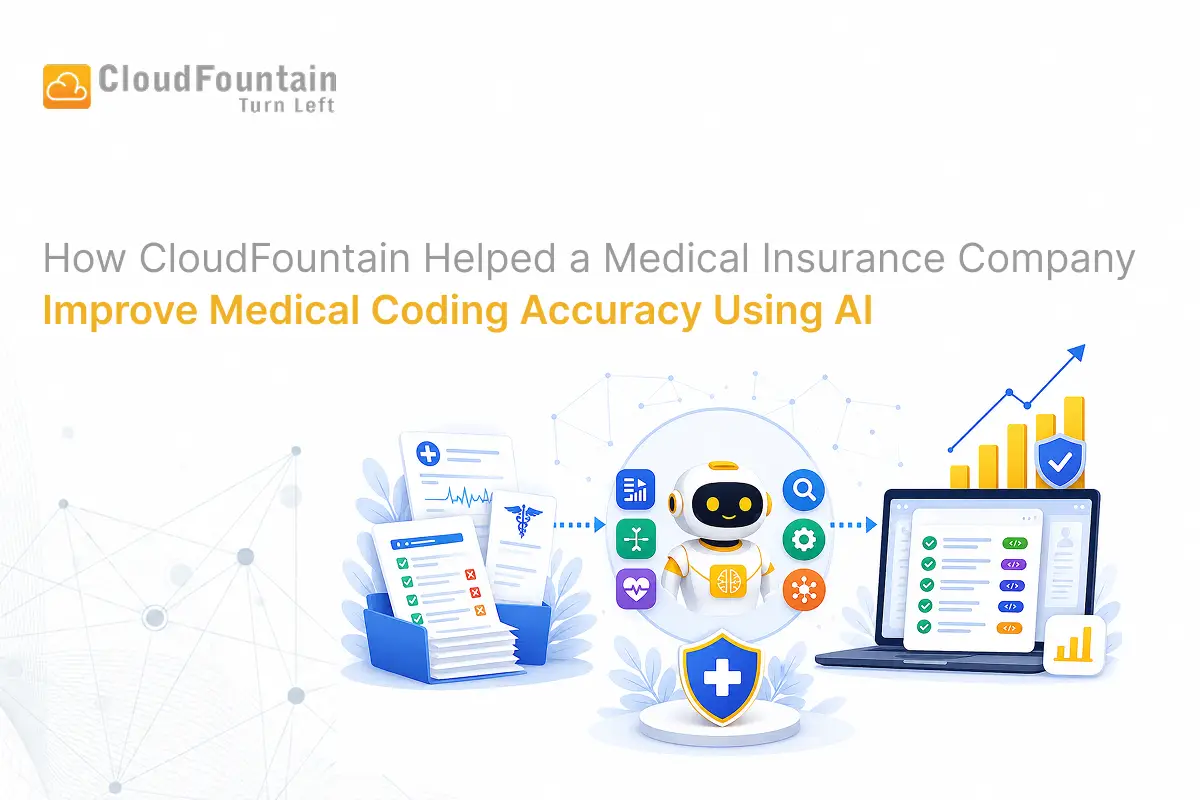
Medical coding plays a critical role in healthcare claims processing. Accurate coding ensures faster claim approvals, reduces reimbursement delays, improves compliance, and minimizes costly denials.
However, coding healthcare claims is becoming increasingly complex. Coding specialists must navigate intricate relationships between clinical documentation, ICD-10 codes, CPT procedures, HCPCS classifications, modifiers, payer-specific requirements, and historical adjudication outcomes.
A leading medical insurance organization partnered with CloudFountain to address these challenges through an AI-powered medical coding training and decision-support platform. The result was improved coding consistency, faster analyst onboarding, reduced claim denials, and a more scalable training framework.
Client Overview
The client is a medical insurance organization responsible for managing large volumes of healthcare claims across multiple providers, specialties, and procedure categories.
As claim volumes increased, maintaining coding quality and training new coding analysts became increasingly difficult. The organization required a smarter approach that could standardize coding decisions while supporting compliance and audit readiness.
The Challenge
Medical coding teams faced several operational and quality-related challenges.
Lengthy Training Cycles
New coding analysts required extensive manual training before becoming fully productive. This created onboarding bottlenecks and increased dependence on senior specialists.
Inconsistent Coding Decisions
Different coders often interpreted similar clinical documentation differently, resulting in inconsistent claim outcomes and varying coding quality.
Incomplete Clinical Documentation
Clinical notes frequently lacked important supporting details required for accurate code selection. Missing information often led to coding errors and claim rework.
Coding Errors and Denials
Incorrect ICD-10, CPT, HCPCS, or modifier selections increased claim denials, reimbursement delays, and administrative overhead.
Overloaded Senior Reviewers
Experienced coding specialists spent significant time answering repetitive questions and reviewing routine coding decisions rather than focusing on high-value cases.
Static Training Processes
Traditional training materials could not adapt to changing payer requirements, denial trends, or historical claim outcomes.
The organization needed an AI solution that could enhance training and coding quality without replacing certified coding professionals.
Why Traditional Medical Coding Training Falls Short
Healthcare coding requires more than memorizing code sets.
Coders must understand:
- Clinical terminology
- Diagnosis relationships
- Procedure documentation
- Payer-specific rules
- Medical necessity requirements
- Historical denial patterns
Traditional training methods often struggle to provide personalized learning experiences or real-time feedback during coding decisions.

CloudFountain’s AI-Powered Medical Coding Solution
CloudFountain developed an AI-enabled training and decision-support framework designed specifically for medical coding teams.
The platform analyzed:
- Clinical notes
- Historical claims data
- Payer rules
- Denial trends
- Approved coding examples
Key Components of the Solution
Clinical Text Understanding
The first step involved advanced Natural Language Processing (NLP).
The system extracted critical healthcare concepts from clinical documentation, including:
- Diagnoses
- Procedures
- Symptoms
- Medications
- Provider notes
- Supporting evidence
Medical Code Recommendation Engine
The recommendation engine analyzed documentation patterns and historical claims intelligence to suggest:
- ICD-10 codes
- CPT codes
- HCPCS codes
- Appropriate modifiers
AI-Powered Training Mode
CloudFountain created an interactive learning environment for coding analysts.
Documentation Gap Detection
The AI automatically flagged situations where selected codes lacked sufficient supporting evidence.
Denial Pattern Learning
The platform continuously analyzed historical denied claims to identify recurring issues such as documentation deficiencies and payer-specific rule mismatches.
Human-in-the-Loop Validation
CloudFountain designed the system with governance and compliance in mind, allowing experts to approve, reject, or modify recommendations.
Results Achieved
- 35% Faster New Coder Training
- 28% Improvement in Coding Review Accuracy
- 40% Reduction in Senior Reviewer Effort
- 22% Reduction in Repeat Coding-Related Denials
Key Takeaways for Healthcare Organizations
- AI should support certified coders rather than replace them.
- Explainable recommendations improve user trust and adoption.
- Documentation gap detection reduces downstream claim issues.
- Human-in-the-loop governance ensures compliance and audit readiness.
The Future of AI in Medical Coding
As healthcare data continues to grow, coding complexity will increase. Organizations that combine AI with experienced coding expertise will be better positioned to manage growing claim volumes.
Conclusion
CloudFountain helped a medical insurance company modernize its coding training and review process through an AI-powered decision-support framework. For healthcare organizations seeking to improve coding quality and operational efficiency, AI-assisted medical coding offers a practical path to better outcomes.