Categories Generative AI

The Role of Generative AI in Drug Discovery and Development

The Role of Generative AI in Drug Discovery and Development

Generative simulated intelligence, a subset of artificial consciousness, is reforming different ventures, including drugs. By utilizing AI calculations, especially brain organizations, it can make new information examples from existing ones. This capacity is ending up a unique advantage in the quest for new prescriptions.

Speeding up the Recognizable proof of New Mixtures

One of the most difficult parts of finding new medicines is recognizing intensifies that could make helpful impacts. Customarily, this cycle has been slow and costly, including broad experimentation. Generative artificial intelligence can speed this up by examining tremendous datasets of known compounds and their belongings, then, at that point, producing new, potential mixtures that could have comparative or worked on restorative properties. This essentially chops down the time and assets expected to track down promising competitors.

Also Read: Generative AI in Healthcare: Benefits and Challenges

Improving Molecular Design

Generative simulated intelligence succeeds at designing new particles with wanted properties. By utilizing models like Generative Adversarial Networks (GANs) or Variational Autoencoders (VAEs), it can make molecules that have never been seen. These models are prepared on datasets of existing particles and figure out how to produce new ones that fit explicit measures, like restricting to a specific protein or being solvent in water. This permits scientists to investigate a lot more extensive substance space than conventional techniques.

Foreseeing Natural Action

Understanding how another compound will associate with natural frameworks is vital. Generative artificial intelligence models can anticipate the organic movement of new particles by gaining from information on existing atoms and their natural impacts. This prescient capacity helps in reducing the tremendous number of potential mixtures to those probably going to be powerful, hence saving time and assets in the beginning phases of the examination.

Also Read: Which Industries benefit most from Generative AI Developments?

Improving Medication like Properties

When a potential compound is distinguished, it should be enhanced for drug-like properties, like steadiness, bioavailability, and negligible secondary effects. Generative simulated intelligence can aid this streamlining system by anticipating what changes to the sub-molecular design will mean for these properties. This iterative course of design and testing can be completed essentially, fundamentally speeding up the improvement timetable.

Lessening Expenses and Expanding Effectiveness

The drug business is known for its significant expenses and long timetables. By coordinating generative AI into the improvement pipeline, organizations can decrease both. The capacity to rapidly create and test new mixtures in silico (utilizing virtual experiences) lessens the requirement for costly and tedious research facility tests. This expanded productivity can prompt lower advancement costs and quicker conveyance of new medicines to patients.

Customized Medication

Generative simulated intelligence additionally holds a guarantee for customized medication. By investigating individual patient information, it can create customized treatment choices custom-made to an individual’s remarkable hereditary cosmetics and sickness profile. This could prompt more powerful medicines with less secondary effects, as treatments are designed explicitly for the individual instead of a one-size-fits-all methodology.

Difficulties and Future Bearings

Notwithstanding its commitment, there are difficulties to executing generative AI in this field. The nature of the produced information is just all around as great as the information used to prepare the models. Hence, guaranteeing top caliber, various datasets is significant. Furthermore, the models should be entirely approved to guarantee their expectations are precise and dependable.

Looking forward, the mix of generative AI with other trend-setting innovations, for example, quantum processing and multi-omics information investigation, could additionally upgrade its abilities. As the innovation develops, it will probably turn into a considerably more vital piece of the drug business, prompting new, imaginative medicines for a large number of sicknesses.

Also Read: Key Considerations for Implementing AI in Healthcare?

Future of Drug Discovery: How Generative AI is Shaping Next Generation of Medicine?

Generative artificial intelligence is changing the way that new prescriptions are found and created. By speeding up the ID of new mixtures, improving sub-molecular design, foreseeing organic action, and streamlining drug-like properties, it offers a more proficient and practical methodology. While challenges stay, what’s in store looks splendid as this innovation proceeds to progress and coordinate with different developments. The potential for customized medication further highlights its commitment, making it an astonishing outskirts in medical care.

For expert guidance on leveraging generative AI in your drug discovery and development processes, contact CloudFountain, a leading provider of Machine Learning Solutions in Boston, USA.

Categories Generative AI, Large Language Model

Generative AI vs. Large Language Models (LLMs): Key Differences

Generative AI vs. Large Language Models (LLMs) Key Differences

Envision we’re fabricating a robot that can visit with you, compose stories, and even assist with schoolwork. To make such a flexible robot, we want two significant innovations: Generative AI and Large Language Models (LLMs). While they could appear to be comparable, it is significant to grasp their disparities. We should jump into the intriguing universe of these advances and perceive how they work in the background.

What is Generative Artificial Intelligence?

Generative AI resembles an inventive craftsman. It’s a part of man-made consciousness zeroed in on making new satisfied, be it text, pictures, music, or even recordings. These artificial intelligence frameworks are intended to create yields that are unique and new, in view of the information they have been prepared on. Consider it a craftsman who has concentrated on numerous artworks and can now make new show-stoppers roused by that information.

Generative AI models work by gaining examples and designs from a tremendous measure of information. Once prepared, they can create new information that looks like the first set. For example, on the off chance that a generative AI is prepared on a dataset of traditional music, it can make new pieces in a similar style. These models utilize complex numerical systems, for example, generative adversarial networks (GANs) or variational autoencoders (VAEs), to create top-caliber, reasonable results.

Also Read: How to Optimize Generative AI Models for Better Performance?

Unloading Large Language Models (LLMs)

Presently, we should discuss LLMs. These are like super-shrewd bookkeepers who know nearly everything about language. LLMs are a particular kind of model inside the more extensive extent of generative simulated intelligence, basically centered around understanding and producing human language. They are prepared on tremendous corpora of text, learning the complexities of punctuation, setting, and even subtleties of various dialects.

An LLM, like GPT (Generative Pre-prepared Transformer), utilizes transformer engineering to process and produce text. This engineering empowers the model to grasp the setting of words in a sentence by checking their connections out. It resembles having a curator who realizes each book as well as comprehends how they all interface and reference one another.

Key Contrasts between Generative AI and LLMs

Here’s where things get intriguing. While both generative AI and LLMs are engaged with making new happy, their degrees and applications vary altogether.

Generative simulated intelligence is an expansive field incorporating any artificial intelligence model that produces new information, not restricted to messages. It incorporates making pictures, music, and the sky is the limit from there. For instance, GANs can make reasonable pictures of individuals who don’t exist by gaining from a dataset of genuine pictures.

LLMs, then again, are accomplished in language undertakings. They succeed at understanding and creating human-like text. This makes them especially helpful for applications like chatbots, interpretation administrations, and content creation. At the point when you communicate with a menial helper that can hold a discussion, it’s probably fueled by an LLM.

Preparing and Design

The preparation cycles of generative artificial intelligence models and LLMs likewise contrast. Generative AI models like GANs include a generator and a discriminator cooperating. The generator makes new information, while the discriminator assesses it. Through this antagonistic interaction, the generator improves until it can create profoundly reasonable results.

Interestingly, LLMs utilize transformer-based engineering, depending on systems like self-regard for grasp setting. They are pre-prepared on large datasets and afterward tweaked for explicit assignments. This pre-preparing permits them to get a handle on complex language designs and create intelligible, logically fitting text.

Practical Applications

Generative AI applications are tremendous. It’s utilized in making deepfake recordings, planning new medication atoms, and in any event, producing workmanship. Its capacity to deliver new, concealed information makes it priceless in numerous imaginative and logical fields.

LLMs, while a piece of generative artificial intelligence, sparkle in errands requiring profound language understanding. They power menial helpers, improve web search tools, and aid the robotized content age. Their capacity to comprehend and create human-like text makes them vital in correspondence advancements.

End Note

Understanding the differentiation between these innovations assists us with valuing their interesting commitments to simulated intelligence progressions. Generative simulated intelligence is the wide craftsman, making assorted types of content, while LLMs are the language specialists, excelling at words. Both are pushing the limits of what machines can make and figure out, each in their own momentous way.

Categories Artificial Intelligence, Generative AI, Machine Learning, Software Development

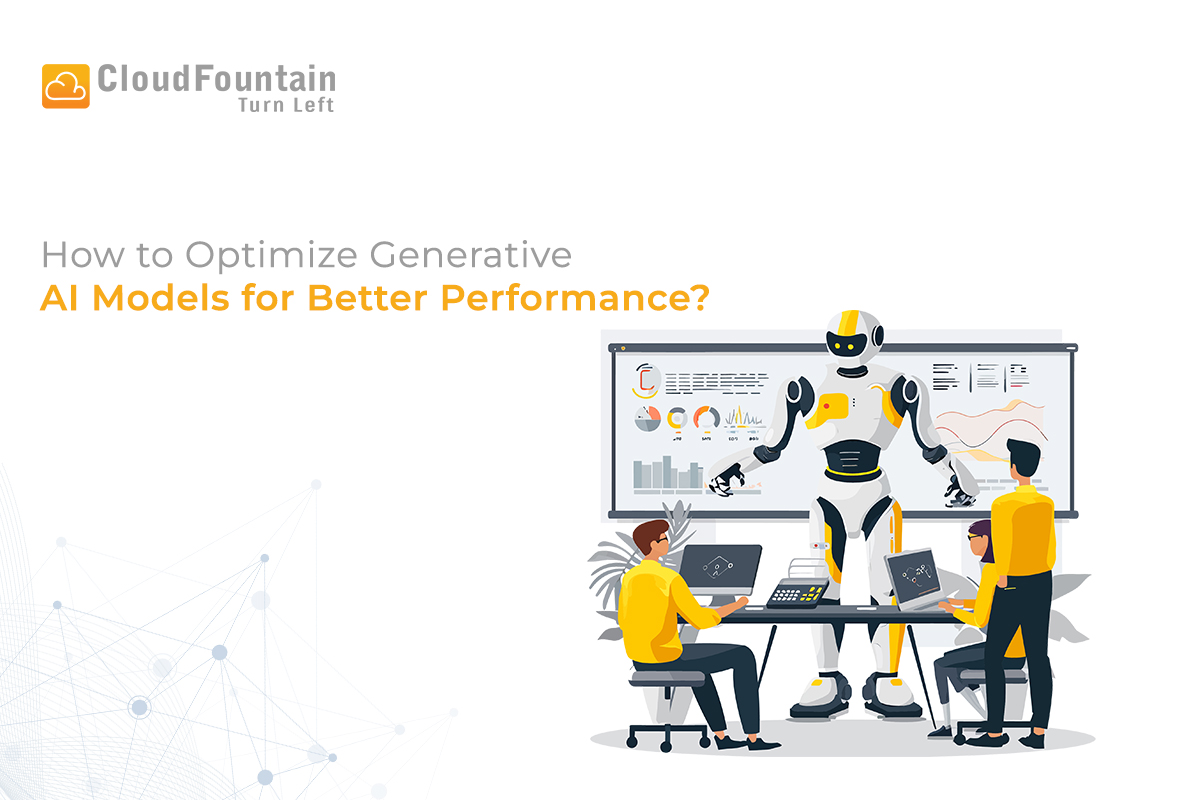
How to Optimize Generative AI Models for Better Performance?

Key Strategies for Optimizing Generative AI Model Performance

Prior to plunging into streamlining, it’s vital to comprehend the design and usefulness of the model you’re working with. This includes knowing the kind of model (e.g., transformer, RNN), the data it was prepared on, and its expected use cases. Really get to know its assets and shortcomings. This basic data will direct your advancement endeavors.

Key Strategies for Optimizing Generative AI Model Performance

Explore essential strategies to enhance the performance of your Generative AI models, from data preprocessing and hyperparameter tuning to leveraging advanced optimization techniques.

Preprocessing Data

Data is the fuel for any artificial intelligence model, and quality data is vital. Begin by cleaning your dataset to eliminate commotion and unessential data. Normalize and standardize your data to guarantee consistency. Use procedures like tokenization, stemming, and lemmatization for text data. Guaranteeing your data is in the most ideal shape assists your model with advancing productively and precisely.

Hyperparameter Tuning

Changing hyperparameters is like calibrating the motor of a vehicle. It can essentially affect the presentation of your model. Explore different avenues regarding different learning rates, bunch sizes, and number of ages. Use network search or irregular hunt to investigate different blends. Automated apparatuses like Optuna or Hyperopt can likewise help with tracking down the ideal settings without manual mediation.

Regularization Methods

To keep your model from overfitting, carry out regularization procedures. Dropout is a famous technique where irregular neurons are overlooked during preparing, advancing overt repetitiveness and vigor. L2 regularization, or weight rot, punishes huge loads, empowering the model to keep loads little and straightforward. Regularization helps in building a model that sums up well to new, concealed data.

Model Engineering Changes

Now and again, the actual engineering needs tweaking. This could include adding or eliminating layers, changing actuation works, or changing the quantity of neurons in each layer. For example, decreasing the quantity of layers can accelerate preparing and surmising times yet could diminish the model’s ability to catch complex examples. Alternately, adding layers can build the model’s ability however may prompt overfitting in the event that not oversaw as expected. Try different things with various models to figure out the perfect balance for your particular use case.

Optimization Calculations

The decision of improvement calculation can definitely influence your model’s presentation. While stochastic gradient drop (SGD) is a typical decision, different calculations like Adam, RMSprop, or AdaGrad could offer better union rates and steadiness. Each streamlining agent enjoys its benefits and compromises, so testing various ones can prompt huge execution upgrades.

Transfer Learning and Calibrating

These use pre-prepared models on huge datasets and tweaks them on your particular dataset. This approach can save time and computational assets while giving areas of strength for a standard. Calibrating includes preparing the pre-prepared model on your data with a more modest learning rate to somewhat change the pre-learned loads. This strategy is particularly successful when you have restricted data.

Checking and Assessment

Constant checking of your model’s exhibition is critical. Use measurements like exactness, accuracy, review, F1 score, and others applicable to your concern space. Imagine the expectations to absorb data to recognize indications of overfitting or underfitting early. Instruments like TensorBoard can give constant bits of knowledge into your model’s preparation cycle.

Carrying out Ensemble Strategies

Gathering techniques consolidate expectations from numerous models to work on in general execution. Procedures like bagging, boosting, and stacking can help in making an additional hearty and precise prescient model. Ensembles decrease the gamble of model-explicit mistakes by averaging out expectations, prompting better speculation.

Accelerating Hardware Speed

Influence the force of GPUs and TPUs for quicker preparing times. These gas pedals are intended to deal with huge scope calculations proficiently. Utilizing structures like TensorFlow or PyTorch, which support equipment speed increase, can altogether diminish preparing times and permit you to emphasize quicker.

Staying aware

The field of artificial intelligence is quickly advancing. Remain refreshed with the most recent exploration, methods, and apparatuses by following pertinent gatherings, diaries, and online discussions. Consolidating state-of-the-art progressions can give better approaches to improving your model’s exhibition.

By consolidating these techniques and keeping a calculated methodology, you can essentially work on the presentation of your generative man-made intelligence models, making them more precise, effective, and dependable.

Also Read: What are the Future Trends in Generative AI Development?

Maximizing Generative AI Performance with Expert Optimization Techniques

Optimizing generative AI models for better performance requires a thorough understanding of the model architecture, diligent data preprocessing, and strategic adjustments to hyperparameters, regularization techniques, and model engineering. By leveraging advanced optimization algorithms, transfer learning, and ensemble methods, you can significantly enhance the accuracy and efficiency of your AI models.

For expert guidance in optimizing your AI models, connect with CloudFountain, a leading Machine Learning Software Development Company in Boston, USA. We offer tailored solutions to help you achieve top-tier performance in AI and machine learning applications. Let us help you take your generative AI models to the next level.

Categories Artificial Intelligence, Generative AI

Generative AI in Healthcare: Benefits and Challenges

Generative AI in Healthcare - Benefits and Challenges

The focus when it comes to the possible transformative nature of technology on health is on Generative AI. This kind of artificial intelligence goes beyond using machine learning to create new knowledge, analyze complex datasets, and find answers to long-standing questions about healthcare. This revolutionizes patient care by synthesizing and interpreting huge amounts of medical data, leading to a reduction in administrative tasks as well as speeding up medical research. In this blog, we are going to explore some pros and cons connected with Generative AI for our healthcare systems.

Benefits of Generative AI in Healthcare

  • Enhanced Diagnostics

One significant advantage that disease diagnosis has experienced with the advent of Generative AI in healthcare is enhancing ailment diagnosis. Traditional diagnostic approaches are often time-consuming and prone to human error. In contrast, generative AI can work out patterns and distinctions from medical images or genetic data or even patients’ backgrounds that no human doctor may ever see or know about.

  • Personalized Treatment Plans

Generative AI has smart, tailor-made treatment plans through the analysis of diverse datasets such as electronic health records and genomic information. In this case, AI algorithms use genetic information, medical history, and lifestyle factors to decide the best treatment options with minimal side effects. This approach optimizes care for patients and limits experimentation with medications.

  • Streamlined Administrative Processes

Healthcare administration requires a lot of work, such as appointment scheduling and managing medical papers, among others. Generative AI could make these processes automatic. Consequently, this will help ease off the non-patient dealing burden on the healthcare provider, letting them focus more on what matters most to their client’s concerns.

Also Read: Key Considerations for Implementing AI in Healthcare

Challenges of Generative AI in Healthcare

  • Data Privacy and Security

Generative AI integrated into the healthcare sector has put data privacy and security at risk. It is important to make sure that patients’ details are kept safe from unauthorized access and breaches. In order to secure sensitive information, healthcare organizations must create and enforce strong security measures aligned with regulations.

  • Bias and Fairness

It is possible for AI algorithms to inadvertently reinforce biases present in training data, leading to unfair treatment recommendations or diagnostic errors. Therefore, there should be a need to develop AI models on diversified datasets containing representations of different populations in order to reduce bias and promote equality in healthcare outcomes for all individuals.

  • Regulatory Compliance

The healthcare industry has many regulations that require one to follow various legal frameworks and ethical standards when deploying artificial intelligence technologies. Trust can be established by meeting regulatory requirements and these systems can be transparent during their decision-making process, hence encouraging wider uptake.

Also Read: How Custom Generative AI Solutions Can Revolutionise Your Business

Conclusion

There is a great future in healthcare brought about by Generative AI that can improve diagnostics, personalize treatment plans, streamline administration, and fast-track medical research. When it comes to generative AI within Healthcare, CloudFountain is ahead of other companies in terms of innovation. We provide cutting-edge solutions designed specifically for healthcare organizations’ unique requirements. Partner with us to harness the power of AI to improve patient outcomes through better diagnostics while saving costs.

Categories Artificial Intelligence, Generative AI, HIPAA Compliance

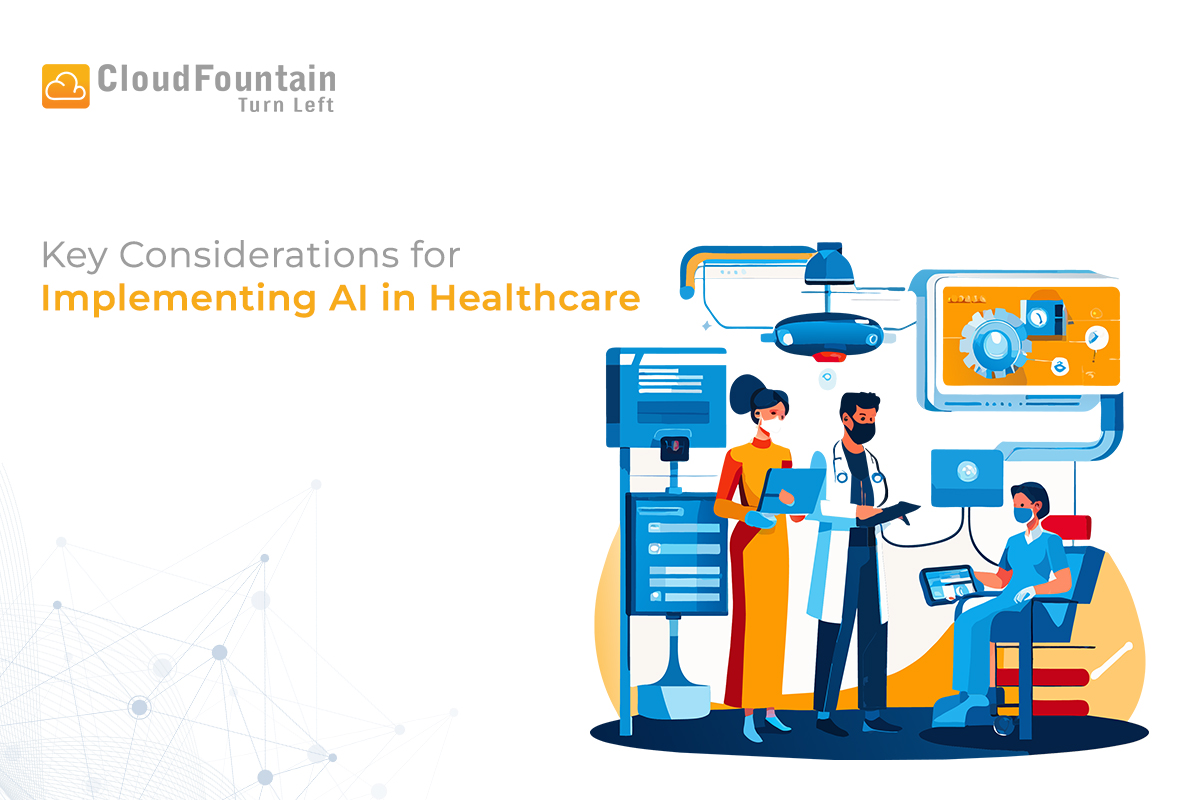
What are Key Considerations for Implementing AI in Healthcare?

Key Considerations for Implementing AI in Healthcare

Essential Considerations for Implementing and Maintaining AI in Healthcare Sector

While executing artificial intelligence in medical services, moral contemplations are central. AI frameworks should be planned and sent in a way that guarantees patient security, protection and assent. It’s vital to address issues of predisposition in artificial intelligence calculations, which can emerge from preparing information that doesn’t satisfactorily address every patient populace.

Guaranteeing reasonableness and value in AI-driven medical care arrangements is essential to abstain from compounding existing safety aberrations. In addition, straightforwardness in simulated intelligence dynamic cycles is crucial to keep up with trust among patients and medical care suppliers. Informed assent is one more basic viewpoint, as patients should know about and consent to the use of AI in their conclusion or treatment.

Information Protection and Security

They are critical worries while executing computer-based intelligence in medical services. Medical services information is exceptionally touchy, and any break can impact people. Robust measures should shield patient information from unapproved access and cyberattacks.

Consistent with guidelines like HIPAA in the US or the GDPR in Europe is required. Guaranteeing that information anonymization and encryption methods are applied can assist with protecting patient data. Also, laying out clear strategies for information administration is fundamental to maintaining the trustworthiness and privacy of medical care information.

Also Read: HIPAA Compliance in Healthcare: Best Practices and Requirements

Coordination with Existing Frameworks

Coordinating AI arrangements with existing medical services frameworks presents difficulties. Medical services suppliers frequently utilize different and complex data frameworks that may not be promptly viable with new AI innovations. Guaranteeing consistent reconciliation requires cautious preparation and coordination. Interoperability guidelines should be complied with, permitting various frameworks to impart and share information.

Moreover, preparing medical care experts to utilize simulated intelligence instruments and decipher their results is essential to boost the advantages of these advancements. Addressing the expected interruption to existing work processes and limiting personal time during the change stage is significant.

Administrative Consistency

Administrative consistency is a fundamental figure in computer-based intelligence in medical services. Computer-based intelligence advancements should satisfy rigid administrative guidelines to guarantee their safety and viability. In the US, the Food and Drug Authority (FDA) manages the endorsement of clinical gadgets, including AI-based devices. Comparable administrative bodies exist in different nations, each with its arrangement of prerequisites.

Exploring these administrative scenes can be intricate and tedious. Engineers should exhibit that their simulated intelligence frameworks are solid, exact, and helpful for patient consideration. Continuous checking and post-market reconnaissance are essential to guarantee consistency and address any arising issues.

Technical Challenges

Carrying out artificial intelligence in medical services includes various technical hurdles. Creating powerful and exact computer-based intelligence models requires top-notch information, which can be hard to get in medical care settings. Information quality issues, like absent or conflicting data, can affect the presentation of computer-based intelligence calculations.

Furthermore, the computational assets expected to prepare and convey simulated intelligence models can be significant. Guaranteeing that these models can work productively progressively in clinical conditions is vital. In addition, resolving the issue of reasonableness, where artificial intelligence frameworks can give justifiable and straightforward thinking to their choices, is significant for acquiring the trust of medical services suppliers and patients.

Looking to implement AI in healthcare? Connect with CloudFountain’s experts to explore key considerations and strategies for a successful AI integration. Our team is here to help you navigate the complexities and maximize the benefits of AI in the healthcare industry. Get in touch with us today!