Categories AI Integration, Generative AI, Generative Artificial Intelligence

Cost-Efficient Agentic AI Workflows For Complex Document Analysis

Cost-Efficient Agentic AI Workflows For Complex Document Analysis

How CloudFountain Built Cost-Efficient Agentic AI Workflows for Complex Document Analysis

Processing thousands of contracts, invoices, compliance reports, and business documents every month can quickly become expensive when every task relies on premium AI models. A professional services organization approached CloudFountain with a challenge: improve document intelligence capabilities while reducing operational and AI processing costs.

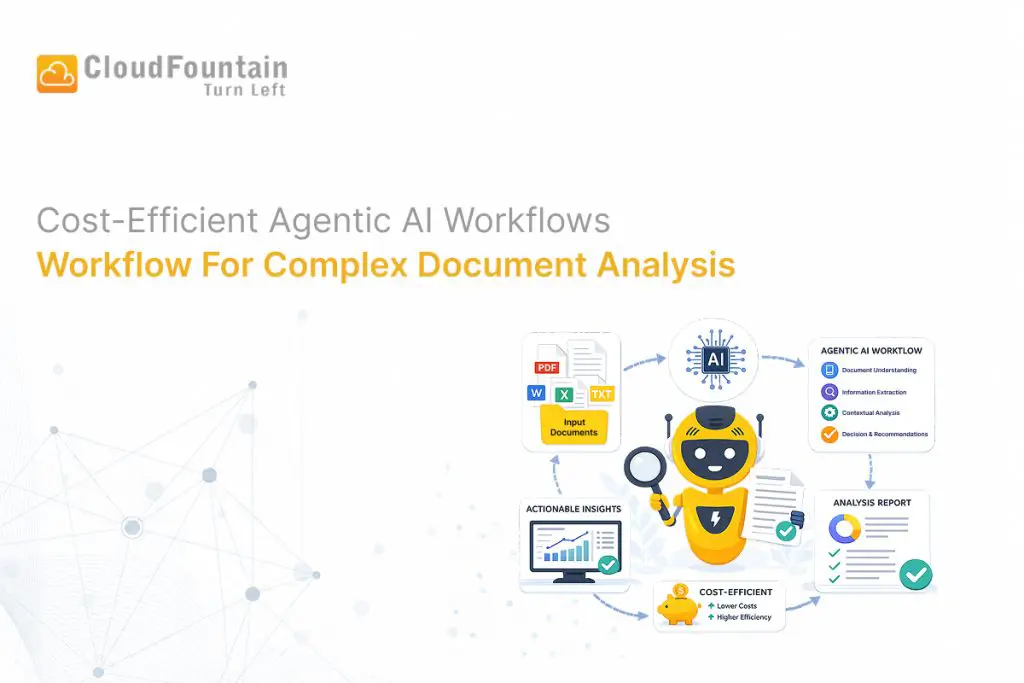
CloudFountain designed and implemented a cost-efficient Agentic AI workflow that combined deterministic automation, intelligent model routing, and tiered AI reasoning. Instead of sending every task to a large language model, the system first identified which activities could be completed using traditional software logic and only invoked AI when genuine reasoning was required.

Scaling Agentic AI Workflows Without Scaling Costs

As enterprise organizations move beyond initial AI experiments, they face a common hurdle: the “scalability gap.” While Generative AI is powerful, relying solely on premium, general-purpose LLMs for high-volume document analysis is often financially unsustainable. The true path to enterprise AI maturity lies in Agentic AI workflows—systems designed not just to “talk” to data, but to intelligently route tasks based on complexity.

By moving from a “model-first” to a “workflow-first” strategy, businesses can automate complex document intelligence while achieving significant cost-efficiency and performance gains.

The Challenge

The client processed more than 2,000 business documents every month, including invoices, contracts, proposals, and compliance reports. Manual review created delays, increased costs, and introduced accuracy issues. At the same time, relying exclusively on premium AI models would have made large-scale document processing financially unsustainable.

The Solution

CloudFountain implemented a deterministic-first architecture designed to minimize unnecessary AI usage while maintaining high-quality outcomes.

  • Automated document parsing and extraction using specialized tools
  • Schema validation and document completeness checks without AI
  • Conditional AI routing based on document complexity
  • Tiered model selection for cost optimization
  • Prompt caching and batch processing for reduced token consumption
  • Agent-based workflows for advanced reasoning and decision support

How the Agentic Workflow Operated

The workflow began with deterministic processing layers that extracted data, validated formats, and checked document completeness. Only documents requiring interpretation, scoring, risk assessment, or business recommendations were routed to AI models.

Simple tasks were handled by low-cost models, while advanced reasoning scenarios were escalated to more capable models. This intelligent routing strategy significantly reduced overall AI expenses without sacrificing accuracy.

Results Achieved

  • 80% reduction in document processing costs
  • 99% document extraction accuracy
  • 70% reduction in manual review effort
  • 85–95% straight-through document processing
  • Significant reduction in AI token consumption
  • Faster turnaround times across document workflows

Business Impact

By combining deterministic automation with Agentic AI, the client transformed document processing from a costly manual operation into a scalable intelligence platform. Teams gained faster access to insights, reduced operational overhead, and improved consistency across business-critical workflows.

The engagement demonstrated that successful AI adoption is not about using the largest model for every task. The greatest value comes from designing intelligent workflows that use the right technology at the right stage of the process. We have applied these same principles of intelligent routing to other complex sectors, including the insurance industry, where we successfully implemented AI-powered lead scoring and agentic workflows to drive conversion.

Agentic AI architecture for document analysis can assist in manual operations.

Key Strategies for Building Agentic AI Architecture

Successfully transitioning to a cost-efficient AI model requires more than just picking a technology—it requires a shift in how you handle data and decisions. Based on our work, here are the foundational pillars that allow organizations to scale AI without increasing their operational budget:

  • Implement a Deterministic-First Strategy: Ensure that standard data extraction, formatting, and validation tasks are handled by traditional code. AI should only be triggered for tasks that require high-level reasoning.
  • Establish Intelligent Model Routing: Not every query requires a frontier model. Build routing logic that directs simple tasks to lightweight, low-cost models and reserves expensive, powerful models for complex, high-stakes decision-making.
  • Leverage Prompt Caching: By caching frequently used instructions and context, you can significantly reduce the number of tokens processed, leading to immediate savings in API costs.
  • Utilize Schema Validation: Use rigid document schemas to catch errors before they reach the AI. This prevents costly “hallucinations” or incorrect extractions that would otherwise require manual human correction.
  • Design for Modular Reasoning: Break large document analysis tasks into smaller, manageable “agentic” steps. This allows you to audit each part of the workflow and optimize individual components for both cost and accuracy.

Conclusion

CloudFountain’s cost-efficient Agentic AI architecture helped the client reduce costs, improve accuracy, and scale document analysis operations without increasing headcount. By combining automation, intelligent model routing, and advanced AI reasoning, organizations can unlock the full value of document intelligence while maintaining complete control over operational expenses.
Categories Uncategorized

How CloudFountain Helped a Medical Insurance Company Improve Medical Coding Accuracy Using AI

How CloudFountain Helped a Medical Insurance Company Improve Medical Coding Accuracy Using AI

Medical coding plays a critical role in healthcare claims processing. Accurate coding ensures faster claim approvals, reduces reimbursement delays, improves compliance, and minimizes costly denials.

However, coding healthcare claims is becoming increasingly complex. Coding specialists must navigate intricate relationships between clinical documentation, ICD-10 codes, CPT procedures, HCPCS classifications, modifiers, payer-specific requirements, and historical adjudication outcomes.

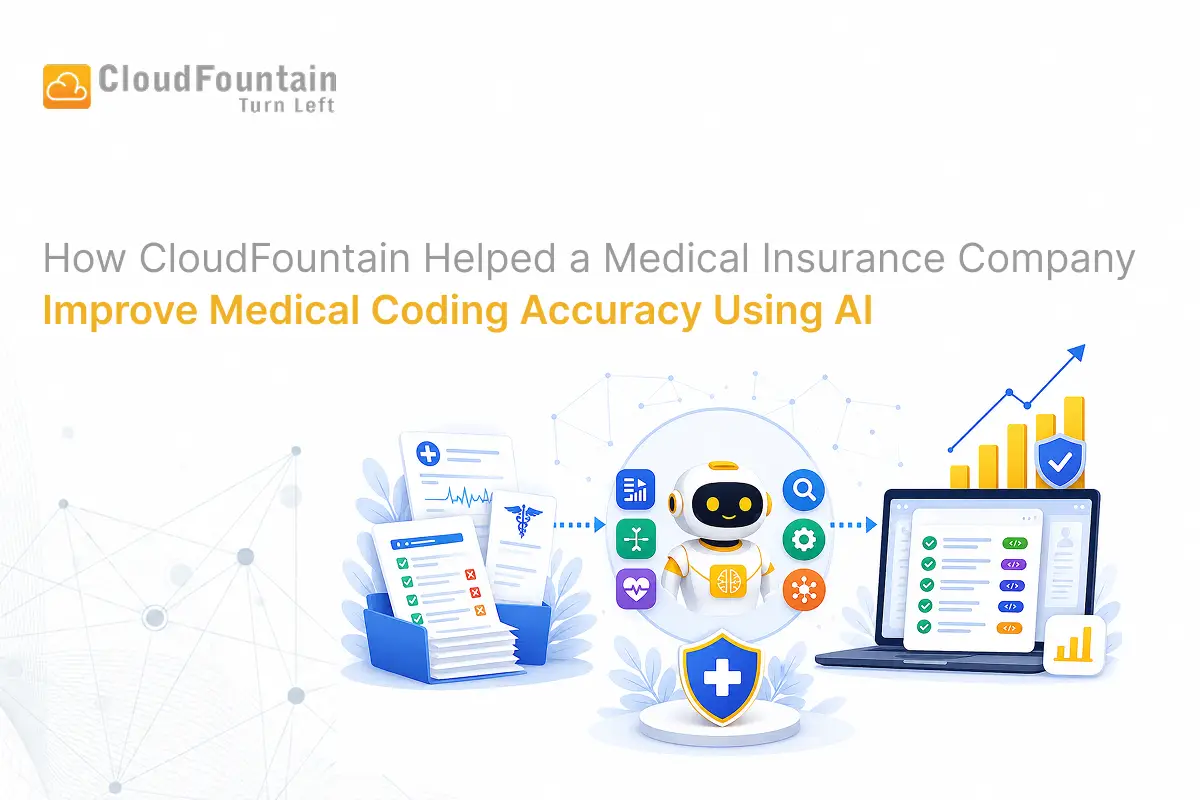
A leading medical insurance organization partnered with CloudFountain to address these challenges through an AI-powered medical coding training and decision-support platform. The result was improved coding consistency, faster analyst onboarding, reduced claim denials, and a more scalable training framework.

Client Overview

The client is a medical insurance organization responsible for managing large volumes of healthcare claims across multiple providers, specialties, and procedure categories.

As claim volumes increased, maintaining coding quality and training new coding analysts became increasingly difficult. The organization required a smarter approach that could standardize coding decisions while supporting compliance and audit readiness.

The Challenge

Medical coding teams faced several operational and quality-related challenges.

Lengthy Training Cycles

New coding analysts required extensive manual training before becoming fully productive. This created onboarding bottlenecks and increased dependence on senior specialists.

Inconsistent Coding Decisions

Different coders often interpreted similar clinical documentation differently, resulting in inconsistent claim outcomes and varying coding quality.

Incomplete Clinical Documentation

Clinical notes frequently lacked important supporting details required for accurate code selection. Missing information often led to coding errors and claim rework.

Coding Errors and Denials

Incorrect ICD-10, CPT, HCPCS, or modifier selections increased claim denials, reimbursement delays, and administrative overhead.

Overloaded Senior Reviewers

Experienced coding specialists spent significant time answering repetitive questions and reviewing routine coding decisions rather than focusing on high-value cases.

Static Training Processes

Traditional training materials could not adapt to changing payer requirements, denial trends, or historical claim outcomes.

The organization needed an AI solution that could enhance training and coding quality without replacing certified coding professionals.

Why Traditional Medical Coding Training Falls Short

Healthcare coding requires more than memorizing code sets.

Coders must understand:

  • Clinical terminology
  • Diagnosis relationships
  • Procedure documentation
  • Payer-specific rules
  • Medical necessity requirements
  • Historical denial patterns

Traditional training methods often struggle to provide personalized learning experiences or real-time feedback during coding decisions.

Medical coding audit

CloudFountain’s AI-Powered Medical Coding Solution

CloudFountain developed an AI-enabled training and decision-support framework designed specifically for medical coding teams.

The platform analyzed:

  • Clinical notes
  • Historical claims data
  • Payer rules
  • Denial trends
  • Approved coding examples

Key Components of the Solution

Clinical Text Understanding

The first step involved advanced Natural Language Processing (NLP).

The system extracted critical healthcare concepts from clinical documentation, including:

  • Diagnoses
  • Procedures
  • Symptoms
  • Medications
  • Provider notes
  • Supporting evidence

Medical Code Recommendation Engine

The recommendation engine analyzed documentation patterns and historical claims intelligence to suggest:

  • ICD-10 codes
  • CPT codes
  • HCPCS codes
  • Appropriate modifiers

AI-Powered Training Mode

CloudFountain created an interactive learning environment for coding analysts.

Documentation Gap Detection

The AI automatically flagged situations where selected codes lacked sufficient supporting evidence.

Denial Pattern Learning

The platform continuously analyzed historical denied claims to identify recurring issues such as documentation deficiencies and payer-specific rule mismatches.

Human-in-the-Loop Validation

CloudFountain designed the system with governance and compliance in mind, allowing experts to approve, reject, or modify recommendations.

Results Achieved

  • 35% Faster New Coder Training
  • 28% Improvement in Coding Review Accuracy
  • 40% Reduction in Senior Reviewer Effort
  • 22% Reduction in Repeat Coding-Related Denials

Key Takeaways for Healthcare Organizations

  • AI should support certified coders rather than replace them.
  • Explainable recommendations improve user trust and adoption.
  • Documentation gap detection reduces downstream claim issues.
  • Human-in-the-loop governance ensures compliance and audit readiness.

The Future of AI in Medical Coding

As healthcare data continues to grow, coding complexity will increase. Organizations that combine AI with experienced coding expertise will be better positioned to manage growing claim volumes.

Conclusion

CloudFountain helped a medical insurance company modernize its coding training and review process through an AI-powered decision-support framework. For healthcare organizations seeking to improve coding quality and operational efficiency, AI-assisted medical coding offers a practical path to better outcomes.

Categories AI Integration

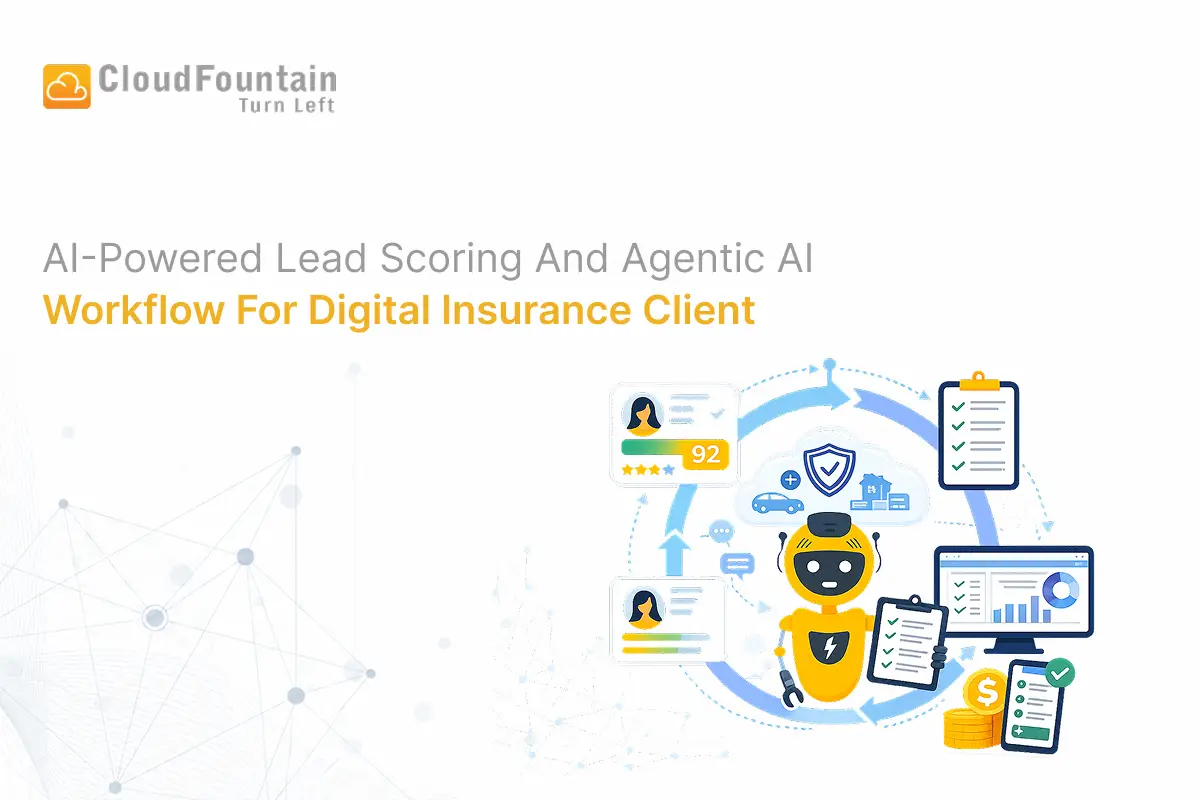
AI-Powered Lead Scoring And Agentic AI Workflow For Digital Insurance Client

AI-Powered Lead Scoring And Agentic AI Workflow For Digital Insurance Client

How AI-Powered Lead Scoring Transformed Insurance Approvals

For digital insurance companies, lead quality directly impacts revenue. Poor-quality leads often result in lower approval rates, wasted marketing spend, and slower policy issuance. Traditional rule-based qualification systems often fail to identify complex risk patterns hidden within customer data.

A leading digital insurance brokerage partnered with CloudFountain to modernize its lead qualification process through AI-powered lead scoring and an agentic AI workflow. The result was a dramatic increase in approval rates, faster decision-making, and significantly improved conversion performance.

The Challenge

The client was experiencing several operational challenges that limited growth and efficiency:

  • Low lead-to-policy conversion rates
  • Manual lead qualification processes
  • High operational costs from human review
  • Complex underwriting requirements
  • Difficulty identifying high-intent prospects
  • Compliance and data privacy concerns

Traditional scoring models relied on static rules and historical assumptions, making it difficult to adapt to changing market conditions and customer behavior.

Benefits of AI-Powered Lead Scoring for Insurance Companies

As competition increases across the insurance industry, AI-powered lead scoring is becoming an essential capability for organizations looking to improve sales performance, underwriting efficiency, and customer acquisition. Rather than relying on fixed qualification rules, AI models continuously analyze new data, identify patterns, and predict which prospects are most likely to convert into profitable policyholders.

By integrating AI-powered lead scoring directly into the lead qualification process, insurance companies can prioritize high-value opportunities, reduce time spent reviewing low-quality submissions, and make faster, more informed decisions. When combined with agentic AI workflows, these systems continuously learn from real-world outcomes, enabling organizations to improve performance over time without extensive manual intervention.

  • Improve lead prioritization using predictive analytics
  • Increase policy approval and placement rates
  • Reduce manual underwriting and qualification effort
  • Deliver faster responses to prospective customers
  • Optimize marketing spend by focusing on higher-quality leads
  • Continuously refine scoring models using live performance data
  • Strengthen compliance through automated validation and audit trails

For organizations seeking to modernize insurance operations, AI-powered lead scoring provides a scalable foundation for smarter decision-making, better customer experiences, and sustainable business growth.

CloudFountain designed and deployed a multi-stage AI-powered lead scoring system supported by agentic AI workflows. The solution automated data gathering, qualification, scoring, and reporting while maintaining enterprise-grade security and compliance standards.

CloudFountain’s Solution

CloudFountain designed and deployed a multi-stage AI-powered lead scoring system supported by agentic AI workflows. The solution automated data gathering, qualification, scoring, and reporting while maintaining enterprise-grade security and compliance standards.

1. Intelligent Data Collection Agent

The first AI agent collected and validated lead information from multiple sources in real time.

  • Applicant verification
  • Data enrichment
  • Financial history validation
  • Identity confirmation
  • Data privacy controls
  • Automated compliance checks

2. AI Lead Scoring Agent

The second agent evaluated every lead using machine learning models trained to identify approval likelihood and policy placement potential.

  • Predictive lead scoring
  • Risk assessment modeling
  • Classification algorithms
  • Continuous learning framework
  • Model drift detection
  • Performance monitoring

3. Reporting & Optimization Agent

The reporting agent continuously monitored outcomes and provided actionable insights for optimization.

  • Lead source analysis
  • Conversion tracking
  • Product performance monitoring
  • KPI reporting
  • Operational intelligence
  • Business rule recommendations

Business Results

The implementation generated measurable business impact across the entire lead lifecycle.

  • 300% Increase in Approval Rates
  • 225% Increase in Policy Placement Rates
  • Conversion Rate Improved from Under 2% to Approximately 4.5%
  • 36% Reduction in Lead Cost Per Policy
  • Sub-Second Lead Qualification Decisions
  • Enhanced Security and Compliance Readiness

Why Agentic AI Made the Difference

Unlike traditional automation systems, agentic AI workflows can reason, adapt, and coordinate across multiple business processes. This enabled the insurance company to automate complex decision-making while maintaining accuracy and compliance.

  • Improved decision quality
  • Reduced manual workload
  • Faster response times
  • Better customer experiences
  • Scalable underwriting support
  • Continuous optimization capabilities

Key Takeaways

Organizations evaluating AI for insurance operations can learn several important lessons from this implementation:

  • AI works best when integrated into operational workflows
  • Lead scoring should continuously evolve using real-world outcomes
  • Compliance and security must be built into the solution from day one
  • Agentic workflows outperform static rule-based systems in complex environments
  • Real-time decisioning creates measurable business value

Conclusion

By implementing AI-powered lead scoring and agentic AI workflows, CloudFountain helped a digital insurance company significantly improve approval rates, reduce operational costs, and accelerate policy placement decisions. The solution transformed lead qualification from a manual process into an intelligent, scalable decision engine capable of driving sustainable growth.

Ready to Improve Insurance Lead Quality with AI?

Discover how CloudFountain can help your organization automate lead qualification, improve approval rates, and accelerate growth with AI-powered workflows.

Book a Consultation

Categories Agentforce

The Future of AI in Customer Service: How Agentforce Is Leading the Way

Agentforce: AI-Driven Customer Service for Salesforce

Customer service is undergoing a fundamental shift. Speed alone is no longer enough. Customers expect accuracy, personalization, and continuity, without repeating themselves or waiting in long queues. Traditional support models, even when digitized, struggle to meet these expectations at scale.

This is where Agentforce is setting a new direction for AI-driven customer service within Salesforce. Rather than acting as a simple Chabot or rule-based automation, Agentforce represents the next stage of intelligent service, where AI agents think, act, and collaborate with humans.

At CloudFountain, we see Agentforce not as a future concept, but as a practical foundation for modern customer service operations.

Why Customer Service Needs a New AI Model

Earlier generations of AI in customer service focused on:

  • Deflecting tickets with FAQs
  • Automating repetitive responses
  • Routing cases using fixed rules

While helpful, these approaches lacked reasoning, adaptability, and true understanding of customer context. They reduced workload, but didn’t significantly improve customer experience.

The future demands AI that can:

  • Understand intent, not just keywords
  • Take action across systems
  • Learn from outcomes and improve continuously

Agentforce is built precisely for this future.

What Makes Agentforce Different from Traditional AI Support

Agentforce introduces autonomous AI agents that operate inside Salesforce Service Cloud environments. These agents are not limited to responding, they can reason through problems, trigger workflows, and support human agents intelligently.

Key capabilities include:

  • Context-aware conversations across channels
  • Autonomous resolution of common service requests
  • Real-time collaboration with human agents
  • Intelligent escalation when human judgment is required

This shifts AI from a support tool to an active service participant.

The Future of AI-Driven Customer Service with Agentforce

  1. From Reactive to Proactive Service

Agentforce enables service teams to identify issues before customers escalate them:

  • Detects recurring patterns and anomalies
  • Triggers proactive outreach
  • Prevents repeat cases through intelligent insights

Customer service becomes preventative, not reactive.

  1. AI Agents as Digital Co-Workers

In the future, AI won’t replace agents, it will work alongside them.

Agentforce supports human agents by:

  • Summarizing customer history instantly
  • Recommending next-best actions
  • Drafting responses aligned with brand tone
  • Reducing cognitive load during complex cases

Agents stay focused on empathy and problem-solving, not system navigation.

  1. Consistency Across Every Channel

Customers interact via chat, email, phone, and social platforms. Agentforce ensures:

  • Unified understanding of the customer journey
  • Consistent answers regardless of channel
  • Seamless handoffs between AI and human agents

This eliminates fragmented service experiences.

  1. Scalable Intelligence Without Linear Headcount Growth

Traditional service scaling means hiring more agents. Agentforce changes the economics:

  • AI handles volume spikes automatically
  • Human agents manage exceptions and high-value interactions
  • Service quality improves without proportional cost increases

This is especially valuable during seasonal demand or rapid business growth.

Trust, Control, and Responsible AI

The future of AI in customer service depends on trust.

Agentforce is designed with enterprise-grade controls:

  • AI actions respect Salesforce permissions
  • Escalation paths ensure human oversight
  • Continuous learning improves accuracy without compromising governance

At CloudFountain, we emphasize structured deployment, ensuring AI enhances trust instead of eroding it.

What This Means for Businesses Moving Forward

Organizations adopting Agentforce gain:

  • Faster response and resolution times
  • Higher customer satisfaction and loyalty
  • Reduced operational strain on service teams
  • Better visibility into service performance

More importantly, they build a service model ready for long-term scalability.

How CloudFountain Helps You Prepare for the AI-Driven Service Future?

We help businesses:

  • Identify high-impact Agentforce use cases
  • Design AI-assisted service workflows
  • Integrate Agentforce with existing Salesforce data and automation
  • Enable service teams to work confidently with AI agents

Our approach ensures AI adoption delivers real outcomes, not complexity.

Final Thoughts

The future of customer service is not about replacing humans with machines. It’s about augmenting human capability with intelligent agents that operate at speed, scale, and precision.

Agentforce is leading this transformation within Salesforce, setting a new standard for how customer service teams operate, collaborate, and deliver value.

Businesses that act now will shape customer expectations tomorrow. Those that wait may find themselves reacting to a service model that has already moved on. With the right strategy, Agentforce allows organizations to move forward with confidence and CloudFountain is ready to guide that transition.

Categories Agentforce

How Agentforce Is Revolutionizing Customer Service in Salesforce

How Agentforce Is Revolutionizing Customer Service in Salesforce

Customer service expectations have changed permanently. Customers now expect instant responses, personalized support, and consistent experiences across every channel. Traditional service models, built around queues, manual triage, and reactive responses, are no longer enough.

This is where Agentforce is reshaping customer service inside Salesforce. By introducing AI-powered agents that can reason, act, and collaborate with human teams, Agentforce moves customer support from case handling to intelligent service orchestration.

At CloudFountain, we see Agentforce as one of the most important shifts in Salesforce Service Cloud in years.

What Is Agentforce in Salesforce?

At its core, Agentforce is Salesforce’s next-generation autonomous AI platform designed to create and deploy specialized digital agents that handle business processes across your entire organization.

Unlike traditional, rigid chatbots that rely entirely on hardcoded “if/then” routing rules, Agentforce functions as an intelligent, reasoning ecosystem. Instead of waiting for a developer to program a script for every possible scenario, these autonomous agents utilize Large Language Models (LLMs) combined with your real-time CRM data to make smart decisions on the fly.

Why Agentforce is in Demand

Early adopter metrics show that the platform’s reasoning capabilities are making a monumental impact. According to official product rollouts discussed in Salesforce’s Global Strategy Briefings, enterprise companies deploying Agentforce are successfully resolving up to 90% of routine customer service inquiries completely autonomously, allowing human service teams to pivot entirely to complex, high-value client needs.

The Limits of Traditional Customer Support Models

Before Agentforce, even well-implemented Service Cloud environments faced challenges:

  • High case volumes overwhelming support teams
  • Long resolution times for repetitive issues
  • Inconsistent answers across agents and channels
  • Reactive service that waits for customers to complain

Automation helped, but only up to a point. Rule-based bots and macros lacked judgment and adaptability.

Agentforce functions as an intelligent, reasoning ecosystem. Instead of waiting for a developer to program a script for every possible scenario, these autonomous agents utilize Large Language Models (LLMs) combined with your real-time CRM data to make smart decisions on the fly.

How Agentforce Transforms Customer Service Operations

Deploying autonomous AI isn’t just about adding a faster chatbot—it is about completely fundamentally restructuring your daily support workflows. By transitioning from rigid, rule-based systems to dynamic, contextual problem-solving, Agentforce acts as an intelligent layer that sits directly over your entire customer service ecosystem. It eliminates operational bottlenecks, automates high-volume ticket queues, and bridges the gap between raw data and instant resolution.

Here is exactly how this autonomous technology redefines the standard customer support lifecycle from start to finish:

  1. Always-On, Intelligent First Response

Agentforce handles initial customer interactions instantly:

  • Understands natural language queries
  • Pulls answers from knowledge bases and CRM data
  • Resolves common requests without agent involvement

Customers get faster responses, while agents receive fewer low-value cases.

  1. Smarter Case Routing and Prioritization

Instead of static routing rules, Agentforce evaluates:

  • Issue urgency
  • Customer history and sentiment
  • SLA risk and business impact

Cases reach the right agent at the right time, improving resolution quality.

  1. Real-Time Agent Assistance

For complex cases, Agentforce works behind the scenes:

  • Summarizes customer history instantly
  • Suggests next-best actions and responses
  • Recommends knowledge articles based on context

Agents spend less time searching and more time solving.

  1. Proactive Service, Not Just Reactive Support

Agentforce enables proactive service by:

  • Identifying patterns before issues escalate
  • Triggering outreach when problems are detected
  • Preventing repeat cases through intelligent insights

Customer service becomes a value driver, not a cost center.

The Impact on Service Metrics That Matter

Organizations adopting Agentforce typically see improvements in:

  • First Contact Resolution (FCR)
  • Average Handle Time (AHT)
  • Customer Satisfaction (CSAT)
  • Agent productivity and retention

By removing repetitive work, agents stay focused, motivated, and effective.

Trust, Governance, and Human Oversight

AI-powered service requires guardrails. Salesforce has designed Agentforce with enterprise controls in mind:

  • AI actions follow defined permissions
  • Human agents remain in control of escalations
  • Continuous learning improves accuracy over time

At CloudFountain, we help organizations design Agentforce deployments that balance automation with accountability.

How CloudFountain Helps You Implement Agentforce Successfully?

Agentforce delivers results only when aligned with real service processes. We help businesses:

  • Identify the right use cases for AI agents
  • Configure Agentforce workflows within Service Cloud
  • Integrate knowledge, data, and automation intelligently
  • Train support teams to collaborate effectively with AI

Our focus is on measurable service outcomes, not experimental AI adoption.

Final Thoughts

Agentforce represents a fundamental shift in how customer service works in Salesforce. Instead of scaling headcount to meet demand, organizations can now scale intelligence.

Customer service becomes faster, more consistent, and more proactive, without losing the human touch where it matters most.

For businesses ready to modernize service operations and exceed customer expectations, Agentforce is not just an upgrade; it’s a new operating model. And with the right strategy, CloudFountain can help you make it work in the real world.