How CloudFountain Built Cost-Efficient Agentic AI Workflows for Complex Document Analysis
Processing thousands of contracts, invoices, compliance reports, and business documents every month can quickly become expensive when every task relies on premium AI models. A professional services organization approached CloudFountain with a challenge: improve document intelligence capabilities while reducing operational and AI processing costs.
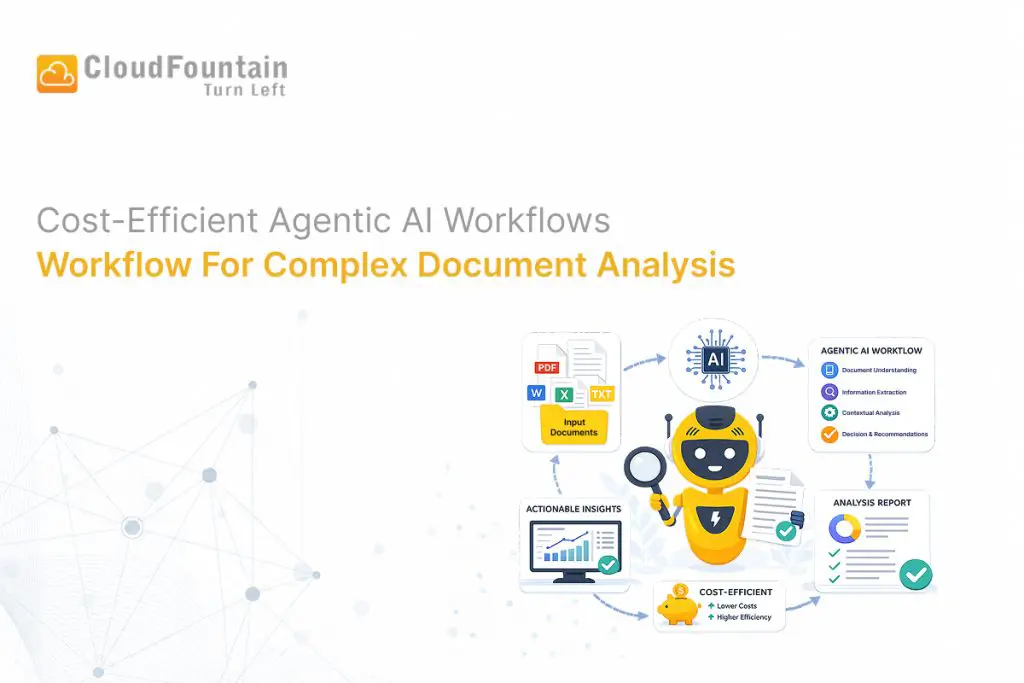
CloudFountain designed and implemented a cost-efficient Agentic AI workflow that combined deterministic automation, intelligent model routing, and tiered AI reasoning. Instead of sending every task to a large language model, the system first identified which activities could be completed using traditional software logic and only invoked AI when genuine reasoning was required.
Scaling Agentic AI Workflows Without Scaling Costs
As enterprise organizations move beyond initial AI experiments, they face a common hurdle: the “scalability gap.” While Generative AI is powerful, relying solely on premium, general-purpose LLMs for high-volume document analysis is often financially unsustainable. The true path to enterprise AI maturity lies in Agentic AI workflows—systems designed not just to “talk” to data, but to intelligently route tasks based on complexity.
By moving from a “model-first” to a “workflow-first” strategy, businesses can automate complex document intelligence while achieving significant cost-efficiency and performance gains.
The Challenge
The client processed more than 2,000 business documents every month, including invoices, contracts, proposals, and compliance reports. Manual review created delays, increased costs, and introduced accuracy issues. At the same time, relying exclusively on premium AI models would have made large-scale document processing financially unsustainable.
The Solution
CloudFountain implemented a deterministic-first architecture designed to minimize unnecessary AI usage while maintaining high-quality outcomes.
- Automated document parsing and extraction using specialized tools
- Schema validation and document completeness checks without AI
- Conditional AI routing based on document complexity
- Tiered model selection for cost optimization
- Prompt caching and batch processing for reduced token consumption
- Agent-based workflows for advanced reasoning and decision support
How the Agentic Workflow Operated
The workflow began with deterministic processing layers that extracted data, validated formats, and checked document completeness. Only documents requiring interpretation, scoring, risk assessment, or business recommendations were routed to AI models.
Simple tasks were handled by low-cost models, while advanced reasoning scenarios were escalated to more capable models. This intelligent routing strategy significantly reduced overall AI expenses without sacrificing accuracy.
Results Achieved
- 80% reduction in document processing costs
- 99% document extraction accuracy
- 70% reduction in manual review effort
- 85–95% straight-through document processing
- Significant reduction in AI token consumption
- Faster turnaround times across document workflows
Business Impact
By combining deterministic automation with Agentic AI, the client transformed document processing from a costly manual operation into a scalable intelligence platform. Teams gained faster access to insights, reduced operational overhead, and improved consistency across business-critical workflows.
The engagement demonstrated that successful AI adoption is not about using the largest model for every task. The greatest value comes from designing intelligent workflows that use the right technology at the right stage of the process. We have applied these same principles of intelligent routing to other complex sectors, including the insurance industry, where we successfully implemented AI-powered lead scoring and agentic workflows to drive conversion.

Key Strategies for Building Agentic AI Architecture
Successfully transitioning to a cost-efficient AI model requires more than just picking a technology—it requires a shift in how you handle data and decisions. Based on our work, here are the foundational pillars that allow organizations to scale AI without increasing their operational budget:
- Implement a Deterministic-First Strategy: Ensure that standard data extraction, formatting, and validation tasks are handled by traditional code. AI should only be triggered for tasks that require high-level reasoning.
- Establish Intelligent Model Routing: Not every query requires a frontier model. Build routing logic that directs simple tasks to lightweight, low-cost models and reserves expensive, powerful models for complex, high-stakes decision-making.
- Leverage Prompt Caching: By caching frequently used instructions and context, you can significantly reduce the number of tokens processed, leading to immediate savings in API costs.
- Utilize Schema Validation: Use rigid document schemas to catch errors before they reach the AI. This prevents costly “hallucinations” or incorrect extractions that would otherwise require manual human correction.
- Design for Modular Reasoning: Break large document analysis tasks into smaller, manageable “agentic” steps. This allows you to audit each part of the workflow and optimize individual components for both cost and accuracy.
Conclusion
CloudFountain’s cost-efficient Agentic AI architecture helped the client reduce costs, improve accuracy, and scale document analysis operations without increasing headcount. By combining automation, intelligent model routing, and advanced AI reasoning, organizations can unlock the full value of document intelligence while maintaining complete control over operational expenses.