Categories Machine Learning

How Does Machine Learning Detect Fraud in Financial Transactions?

How Does Machine Learning Detect Fraud in Financial Transactions

Fraud Detection in the Financial Sector with Machine Learning (ML) – An Overview

The phenomenon is unavoidable and it fundamentally influences the trustworthiness and security of financial frameworks globally. Identifying fake exchanges is critical to maintaining trust and steadiness inside financial business sectors. Customary techniques for fraud identification, for example, rule-based frameworks and manual audits, have demonstrated lacking because of the rising intricacy and volume of exchanges. AI (ML) offers a modern way to deal with distinguishing peculiarities and foreseeing false ways of behaving with higher exactness and productivity.

AI Strategies for Fraud Recognition

Flowchart of Fraud Detection Using Machine Learning

This flowchart outlines the comprehensive process of fraud detection using machine learning. It covers key stages including Data Collection, Data Preprocessing, Feature Extraction, Model Training, Model Validation, Deployment, Monitoring and Updating, and Alert Generation. Each step is crucial for building an effective fraud detection system, ensuring accurate identification and response to fraudulent activities.

Supervised Learning

It includes preparing a model on a named dataset, where deceitful and non-fake exchanges are checked. Procedures, for example, logistic regression, decision trees, support vector machines (SVM), and neural networks are ordinarily utilized in this unique situation. These models become familiar with fake ways of behaving and apply this information to new exchanges to anticipate the probability of extortion.

  • Logistic Regression: Logistic regression gives probabilistic results, making it reasonable for risk evaluation.
  • Decision Trees: Decision trees offer interpretability.
  • Support Vector Machines: SVMs are compelling in high-layered spaces.
  • Neural Networks: They, along with deep learning models, succeed in catching complex examples through numerous layers of deliberation.

Unsupervised Learning

Experts use it when there is a scarcity of labeled data.

  • Clustering: Clustering calculations like K-Means, hierarchical clustering, and DBSCAN can group comparative exchanges, featuring anomalies that might demonstrate fraud.
  • Anomaly Detection: Random Forests and One-Class SVMs distinguish exchanges that deviate from the standard.

Random Forests segregate peculiarities by haphazardly parceling information and distinguishing focuses that are simpler to isolate. One-class SVMs, then again, model the ordinary class and order deviations as inconsistencies.

Feature Engineering and Selection

Successful fraud identification relies on the nature of elements removed from the exchange information. Exchange recurrence, spatial highlights, value-based sum, vendor classification, installment strategy, etc, are essential. Highlight choice procedures, including Recursive Feature Elimination (RFE) and Principal Component Analysis (PCA), recognize the most enlightening highlights and lessening dimensionality, in this manner upgrading model execution.

Model Assessment and Approval

Assessing fraud detection models requires an emphasis on measurements that address class irregularity, as deceitful exchanges commonly comprise a small part of the complete exchanges. Accuracy, review, and F1-score are preferable over exactness. Accuracy estimates the extent of genuine fakes. The F1 score harmonizes the two.

Cross-validation strategies – k-means cross-validation techniques ensure the model strength. Moreover, defined examining keeps up with the extent of fraud cases in each overlay, offering a practical assessment.

Real-time Detection and Scalability

Streaming systems like Apache Kafka and Apache Flink empower the ingestion and handling of exchange information continuously. Procedures identify the extortion while taking care of the speed and volume of financial transactions.

Difficulties and Future Bearings

Regardless of the headways, a few difficulties persevere in extortion recognition. The developing idea of extortion strategies requires nonstop model updates and flexibility. Information security concerns likewise force limitations on information sharing and model preparation. Moreover, the interpretability of intricate models, for example, profound learning organizations, remains a worry for administrative consistency and trust.

To learn more about how machine learning detects fraud and explore effective strategies for your business, reach out to CloudFountain, a leading Machine Learning Development Company in Boston USA. We offer comprehensive Machine Learning Solutions in USA to help you stay ahead of fraud risks. Contact us today for expert advice and tailored solutions!

Categories Artificial Intelligence, Machine Learning

What Ethical Challenges are associated with AI and Machine Learning?

What Ethical Challenges are associated with AI and Machine Learning

Artificial Intelligence (AI) and Machine Learning (ML) are revolutionizing industries, including customer relationship management (CRM) systems like Salesforce. These technologies bring unparalleled efficiencies and insights, but they also introduce significant ethical challenges. At CloudFountain, where we specialize in Salesforce services for entrepreneurs, we recognize the importance of addressing these ethical issues. Understanding and mitigating these challenges is crucial for ensuring that AI and ML advancements benefit society responsibly.

Ethical Artificial Intelligence

1.     Bias and Fairness

One of the most pressing ethical concerns in AI and ML is bias. Algorithms are trained on historical data, which may contain biases reflecting societal prejudices. If not addressed, these biases can perpetuate or even exacerbate existing inequalities. For instance, biased algorithms might result in discriminatory lending practices or biased hiring processes.

Mitigation Strategies:

  • Diverse Training Data: Use diverse and representative datasets to train AI models.
  • Bias Detection Tools: Implement tools to detect and correct biases in algorithms.
  • Regular Audits: Conduct regular audits of AI systems to ensure fairness and impartiality.

2.     Privacy and Data Security

AI and ML systems often require vast amounts of data, raising significant privacy concerns. The collection, storage, and analysis of personal data must comply with stringent privacy regulations to protect individuals’ rights.

Mitigation Strategies:

  • Data Anonymization: Use techniques to anonymize data, reducing the risk of exposing personal information.
  • Compliance with Regulations: Adhere to privacy laws such as GDPR and CCPA.
  • Robust Security Measures: Implement strong security protocols to protect data from breaches.

3.     Transparency and Accountability

AI and ML models, particularly deep learning networks, can be complex and opaque, making it difficult to understand how decisions are made. This lack of transparency can lead to a lack of accountability, especially when AI systems make significant decisions affecting individuals and businesses.

Mitigation Strategies:

  • Explainable AI: Develop AI models that can explain their decision-making processes in understandable terms.
  • Clear Accountability Structures: Establish clear accountability structures to hold developers and users responsible for AI outcomes.
  • Stakeholder Involvement: Engage stakeholders in the development and deployment of AI systems to ensure transparency and trust.

4.     Job Displacement

The automation capabilities of AI and ML can lead to job displacement, particularly in industries where tasks are repetitive and easily automated. This raises ethical concerns about the social and economic impacts on workers.

Mitigation Strategies:

  • Reskilling Programs: Invest in reskilling programs to help workers transition to new roles.
  • Human-AI Collaboration: Design AI systems that augment human capabilities rather than replace them.
  • Social Safety Nets: Advocate for policies that provide social safety nets for displaced workers.

5.     Ethical Use of AI in Decision-Making

AI systems are increasingly used in decision-making processes, from credit scoring to law enforcement. Ethical challenges arise when these systems make life-altering decisions without human oversight.

Mitigation Strategies:

  • Human Oversight: Ensure that critical decisions made by AI systems include human oversight and intervention.
  • Ethical Guidelines: Develop and adhere to ethical guidelines for AI use in decision-making.
  • Impact Assessments: Conduct impact assessments to evaluate the potential consequences of AI decisions on individuals and communities.

6.     Sustainability

The environmental impact of AI and ML, particularly the energy consumption of large-scale data centers, is another ethical concern. Sustainable practices are essential to mitigate the carbon footprint associated with AI technologies.

Mitigation Strategies:

  • Energy-Efficient Algorithms: Develop and use energy-efficient algorithms to reduce power consumption.
  • Green Data Centers: Invest in green data centers powered by renewable energy.
  • Sustainability Goals: Set and pursue sustainability goals in AI development and deployment.

Conclusion

AI and ML offer transformative potential for Salesforce and beyond, but they also come with significant ethical challenges. At CloudFountain, we are committed to helping entrepreneurs navigate these challenges responsibly. By prioritizing fairness, transparency, privacy, accountability, and sustainability, we can harness the power of AI and ML while ensuring these technologies serve the greater good.

Addressing these ethical issues is not just a technological challenge but a societal imperative. As we continue to innovate and integrate AI into our services, we must do so with a keen awareness of the ethical landscape, striving to create a future where technology enhances human well-being and equity.

For more information on how CloudFountain can help you leverage Salesforce with ethical AI and ML practices, contact us today. Together, we can build a responsible and sustainable digital future.

Categories Artificial Intelligence, Machine Learning, Salesforce, Salesforce Einstein

Understanding the Influence of Machine Learning on Healthcare: Trends and Insights

Machine Learning on Healthcare: Trends and Insights

Bringing machine learning into healthcare is like giving doctors a superpower. The impressive growth expected in the global AI ML (Artificial Intelligence/Machine Learning) in global healthcare from 2023-2030 market is 37.5% CAGR.

The healthcare industry has always been at the forefront of adopting cutting-edge technologies, and the integration of machine learning (ML) has opened up a plethora of transformative possibilities.

With all the data that medical systems have on patients, machine learning can help them spot trends and patterns that might be impossible for doctors to analyse.

In recent years, Salesforce has transcended its traditional role in customer relationship management (CRM) to become a pivotal force in healthcare. By harnessing its advanced ML capabilities, Salesforce is revolutionising patient care delivery, operational management, and patient engagement.

This blog post delves into the current trends and insights, showcasing how Salesforce’s machine learning innovations are reshaping the healthcare landscape.

How does Salesforce enhance Futuristic Healthcare Interaction?

Machine learning algorithms deliver personalised patient experiences. By analysing patient data, including medical history, preferences, and behaviours, healthcare providers can tailor communications and care plans to individual needs. This personalization increases patient satisfaction and adherence to treatment plans.
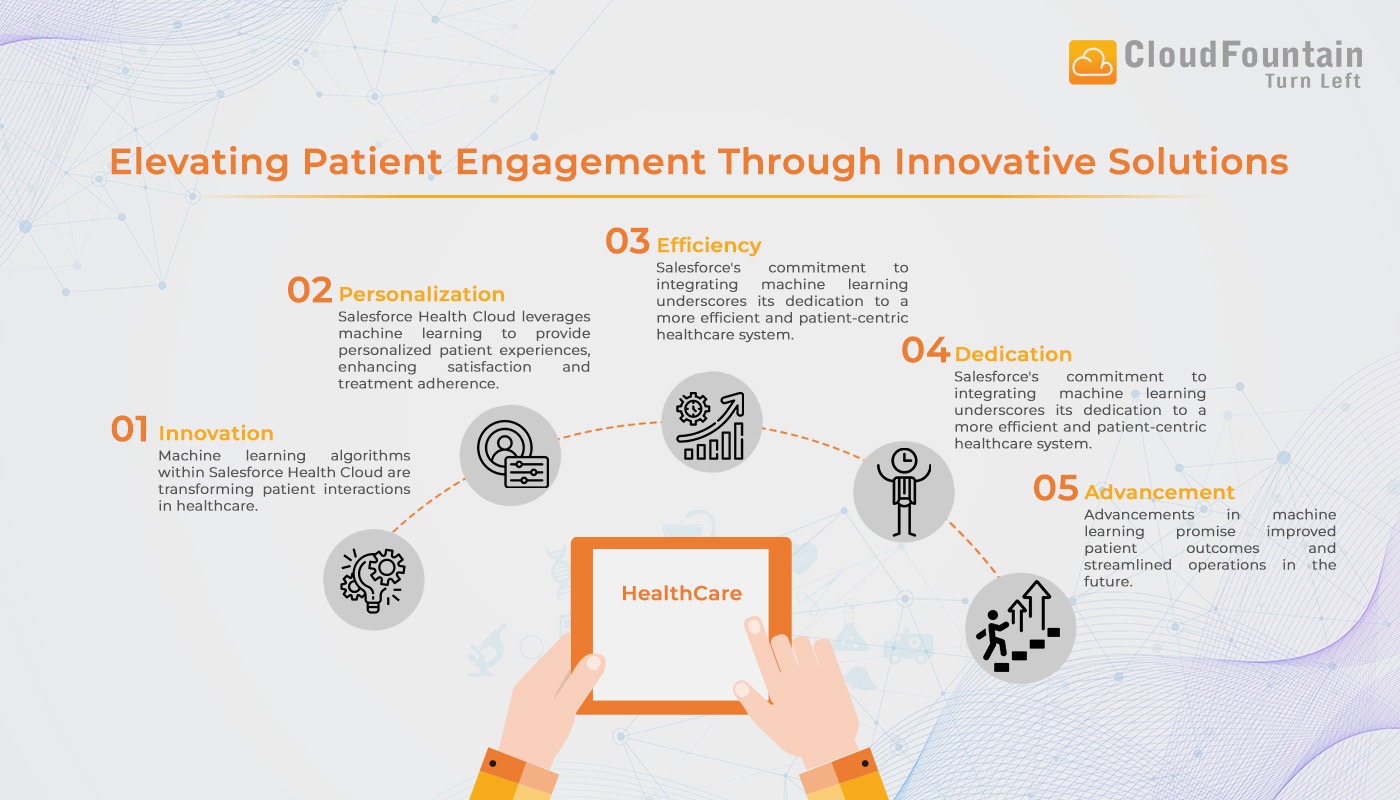
Elevating Patient Engagement through Innovative Solutions

Personalized Patient Interactions

Salesforce Health Cloud leverages machine learning to provide personalised patient experiences. By analysing patient data, including medical history, preferences, and behaviours, healthcare providers can customise communications and care plans to suit individual needs. This tailored approach enhances patient satisfaction and improves adherence to treatment plans.

In addition, Salesforce Health Cloud offers a comprehensive CRM platform specifically designed for healthcare providers, payers, and pharmaceutical companies. It encompasses features that harness machine learning to enhance healthcare delivery, such as:

  • Centralised patient data management for a holistic view
  • Facilitation of care team collaboration for coordinated care
  • Personalised patient engagement through communication and reminders
  • Predictive analytics-driven identification of high-risk patients for proactive management.

Salesforce’s incorporation of machine learning into these capabilities underscores its dedication to revolutionising healthcare. By improving patient engagement, personalising interactions, and employing predictive analytics.

Predictive Patient Outreach

Predictive Patient Outreach utilises predictive analytics powered by machine learning to anticipate patient deterioration, risks of hospital readmission, and potential complications. This foresight enables healthcare providers to implement preventative measures, ultimately improving patient outcomes and reducing healthcare costs.

Salesforce offers a suite of capabilities that enable healthcare organisations to conduct effective predictive patient outreach. With Salesforce Health Cloud, comprehensive patient data is aggregated, allowing machine learning algorithms to analyse patterns and trends. This analysis empowers healthcare providers to identify patients at risk or in need of follow-up care.

Salesforce Einstein Analytics

Additionally, Salesforce Einstein Analytics integrates advanced analytics and AI capabilities to provide deep insights and predictive analytics. These capabilities include predictive analytics, which uses machine learning to forecast patient outcomes and identify at-risk individuals, as well as operational efficiency analysis to optimize resource allocation, improve workflow efficiency, and reduce costs. Furthermore, clinical data analysis provides insights from clinical data to enhance diagnostic accuracy and treatment efficacy.

Automating Administrative Tasks for Seamless Operations

Administrative tasks, such as appointment scheduling, billing, and insurance claims processing, can be automated using machine learning. Natural Language Processing (NLP) algorithms can handle patient queries and documentation, freeing up healthcare professionals to focus on direct patient care. For example, voice-to-text transcription services can convert doctors’ notes into electronic health records (EHRs) in real-time, enhancing efficiency and accuracy.

Fortunately, Salesforce offers a variety of tools that help streamline administrative tasks and optimise resource allocation.

Salesforce Health Cloud Features

  1. Automating Administrative Tasks with Salesforce Health Cloud: Salesforce Health Cloud, healthcare providers can automate routine administrative tasks like appointment scheduling and patient registration. This not only saves time but also reduces the risk of errors, allowing staff to focus more on delivering excellent care to patients.
  2. Streamlining Patient Inquiries with Salesforce Service Cloud: Salesforce Service Cloud provides case management features that automate the handling of patient inquiries and requests. Through intelligent routing, cases are directed to the right staff members for quick resolution. Plus, self-service portals empower patients to access information and schedule appointments independently, further easing the administrative burden on staff.
  3. Forecasting Patient Demand with Salesforce Einstein Analytics: With Salesforce Einstein Analytics, healthcare organisations can gain valuable insights into patient demand for services. Predictive analytics models forecast future demand, enabling providers to allocate resources more effectively. Real-time data monitoring allows for proactive decision-making to address resource shortages or surpluses as they arise.
  4. Managing Healthcare Data with Machine Learning: Machine learning plays a vital role in managing and analysing the ever-expanding volume of healthcare data. With efficient data management systems, healthcare organisations can integrate and analyse data from diverse sources, yielding comprehensive patient insights crucial for large-scale health initiatives and research projects.
  5. Optimising Resource Allocation with Predictive Models: Salesforce offers solutions to optimise resource allocation by leveraging historical data and current trends. Through predictive models, Salesforce assists healthcare organisations in forecasting demand for services, ensuring optimal utilisation of staffing, equipment, and inventory.
  6. Seamless Integration with Salesforce MuleSoft: Moreover, Salesforce MuleSoft facilitates seamless integration of various healthcare systems and data sources. By automating data retrieval and sharing processes, MuleSoft reduces manual errors and ensures that information from electronic health records and other sources is readily accessible and actionable.

Also Read: Benefits Of MuleSoft Anypoint Platform

Furthermore, the Salesforce AppExchange provides a plethora of third-party applications tailored to healthcare needs. These tools, such as workflow automation and document management systems, streamline administrative processes like documentation and reporting, allowing healthcare staff to dedicate more time to patient care.

By harnessing these Salesforce capabilities, healthcare organisations can enhance operational efficiency, streamline workflows, and ultimately deliver superior patient care.

Pioneering Drug Development through Data Insights

Salesforce’s machine learning tools play a pivotal role in accelerating drug development and enhancing clinical trials.

By aggregating and analysing data from various sources, including clinical trials and genomic research, Salesforce facilitates faster and more efficient identification of promising drug candidates.

This expedites the research phase, bringing new treatments to market more rapidly. In addition, machine learning algorithms improve the design and execution of clinical trials by identifying suitable participants, predicting outcomes, and monitoring progress in real-time.

Salesforce Health Cloud’s capability to integrate and analyse diverse datasets ensures that trials are more efficient and have higher success rates. Furthermore, Salesforce Tableau offers powerful data visualisation and business intelligence capabilities. It creates interactive and intuitive dashboards to visualise healthcare data, enabling healthcare providers to explore insights and trends for informed decision-making. Additionally, Tableau generates comprehensive reports to track performance metrics and outcomes, further enhancing the efficiency and effectiveness of drug development and clinical trials.

Addressing Challenges and Ethical Considerations

Data Privacy and Security are paramount concerns in the era of big data, especially in healthcare where sensitive patient information is involved. Partnering with CloudFountain helps healthcare organisations to prioritise compliance with regulations. Here is how Cloudfountion can help you with the compliances:

  • GDPR and HIPAA implement robust security measures to safeguard patient data. Machine learning algorithms further enhance security by detecting and responding to potential threats.
  • Our seasoned experts guide your digital transformation journey strategically.
  • Prioritising budget control while keeping your business at the forefront of digital advancement.

Choosing CloudFountain’s consulting services in Boston, USA helps you to partner with an innovative and reliable ally.

Also Read: HIPAA Compliance In Healthcare: Best Practices And Requirements

The Future of Salesforce Machine Learning in Healthcare

The future of Salesforce machine learning in healthcare is promising, with continuous advancements expected to bring even more sophisticated applications. These may include advanced telemedicine services, enhanced patient monitoring through IoT integration, and the development of more personalised treatment plans. Salesforce’s commitment to innovation, coupled with its strong emphasis on ethical practices, positions it as a leader in the healthcare technology landscape.

Furthermore, Salesforce offers additional capabilities through its various platforms, extending its reach in healthcare:

  • Salesforce AppExchange: Offers a variety of third-party applications tailored for healthcare, including EHR integrations for seamless data exchange, telehealth solutions enabling remote consultations, and health and wellness apps supporting chronic disease management.
  • Salesforce MuleSoft: Facilitates integration of diverse healthcare systems and data sources, enabling data integration, API management for secure data exchange, and workflow automation to improve efficiency.
  • Salesforce Community Cloud: Fosters collaboration and communication among patients, providers, and caregivers through patient communities, provider collaboration tools, and knowledge-sharing platforms.
  • Salesforce Service Cloud: Enhances patient support and care management with features like case management, omni-channel support, and self-service portals for patients.
  • Salesforce IoT: Connects and analyses data from medical devices and wearables for real-time monitoring, proactive alerts, and data integration with EHRs for a comprehensive view of patient health.
  • Salesforce Tableau: Delivers powerful data visualisation and business intelligence capabilities, enabling healthcare providers to create interactive dashboards, explore data insights, and generate comprehensive reports for informed decision-making.

These Salesforce capabilities play a vital role in transforming the healthcare industry, enhancing patient care, improving operational efficiency, and enabling data-driven decision-making.

How Can You Integrate Salesforce Into Your Healthcare Systems?

CloudFountain stands out as a leading provider of Salesforce Integration Solutions in Boston, USA. Our team comprises seasoned and qualified Salesforce personnel with expertise in developing and integrating Salesforce modules. There are compelling reasons to choose us:

  • We meticulously scrutinise the right Salesforce alternatives tailored to your specific needs.
  • Our implementation process is precise and accurate, ensuring seamless integration and functionality.
  • We guarantee the effectiveness of the applications we develop, leveraging our industrial experience and expertise.
  • With our ongoing support and service, we ensure that your Salesforce solutions continue to meet your evolving needs.

With CloudFountain as your trusted partner, you can rest assured that your Salesforce integration needs are in capable hands, driving your organisation towards greater efficiency, effectiveness, and success in the healthcare domain.

Final Thought

Machine learning revolutionises healthcare, promising improved patient care and cost reduction. Yet, ethical and privacy challenges must be addressed. Salesforce’s machine learning advancements enhance patient engagement, clinical support, operations, and drug development. Integrating these technologies can boost outcomes and efficiency. CloudFountain, a premier Salesforce Integration Company in Boston USA, offers tailored solutions with precise implementation and ongoing support. With a focus on effectiveness and expertise, we scrutinise alternatives, ensuring seamless integration and optimal application. Choose CloudFountain for transformative Salesforce integration, driving efficiency and success in healthcare.

Categories Compliance Services

Navigating Compliance Challenges for Small and Mid-Size Businesses: A Guide to Success

Navigating Compliance Challenges for Small and Mid-Size Businesses - A Guide to Success

In today’s rapidly evolving regulatory landscape, small and mid-size businesses face an increasing array of compliance challenges. Navigating through these complexities requires both a deep understanding of the regulatory environment and an intimate understanding of the challenges faced by small and midsize businesses. CloudFountain recognizes these challenges and stands as a beacon of support for businesses seeking to balance compliance excellence with operational efficiency. With over two decades of industry expertise, CloudFountain offers unparalleled compliance, consulting, and technology services tailored to your unique needs.

The Challenges Faced by Small and Mid-Size Businesses

Businesses will encounter numerous hurdles on their compliance journey. One of the primary challenges is identifying what aspects of a compliance framework are mandatory, what are optional, and how to meet the new requirements while keeping the operation running.  This challenge is particularly acute for small and mid-size businesses, where lean teams are already working on multiple projects and have to find the right balance between compliance and operational efficiency. Many businesses struggle to allocate resources effectively and prioritize appropriately, often resulting in overwhelmed staff and disjointed compliance efforts.

Small and mid-size teams face the challenging task of balancing industry-specific requirements with limited resources and multiple priorities. For these businesses, it’s crucial to find a compliance approach that can accommodate these challenges effectively. For these businesses, finding a partner who understands their industry-specific needs, has practical experience, and possesses the technical expertise to address them is essential. However, given the constraints of limited resources and competing priorities, this search can be daunting. Small and mid-size businesses require a partner who not only brings expertise but also understands the unique challenges they face in balancing compliance obligations with day-to-day operations

Why Choose CloudFountain?

At CloudFountain, we understand these challenges firsthand. We’ve walked in the shoes of businesses grappling with compliance, and we know the frustrations and uncertainties that accompany the process. Our mission is to alleviate these burdens by offering a comprehensive suite of services designed to streamline compliance efforts and mitigate risk. We recognize that small and mid-size businesses need more than just a cookie-cutter approach to compliance; they need tailored solutions that take into account their specific resources and competing priorities.

Our team is committed to working closely with you to develop customized compliance strategies that align with your unique needs and objectives. We understand the importance of finding the right balance between compliance and operational efficiency, and we’re here to help you navigate this delicate equilibrium. With our expertise and understanding, we empower small and mid-size businesses to achieve compliance excellence without sacrificing productivity or profitability.

What sets CloudFountain apart is not just our impressive legacy of industry expertise but our ability to dig into your IT architecture and help your team address the root challenges. Our team takes the time to truly understand your unique requirements, ensuring that every security policy, procedure, and your core infrastructure meets regulatory standards.

By partnering with CloudFountain, small and mid-size businesses can leverage our experience, technical prowess, and dedication to streamline their compliance efforts and achieve their goals. We’re more than just a consultancy; we’re a trusted partner committed to helping you succeed in today’s complex regulatory environment.

A Three-Step Process

At CloudFountain, we advocate a three-step process to guide businesses through their compliance journey, ensuring a tailored approach that meets their specific needs. Our process makes use of both our personalized experience and Drata, the latest in compliance automation platforms.

Phase 1: Understanding Your Needs

The first phase of the process revolves around understanding your business and its compliance objectives. This phase includes:

  1. Initial Consult: Experts sit down with you to understand your goals, priorities, and pain points. What are you looking to achieve with compliance, and why is it important to your business? By gaining insight into your motivations and aspirations, we can tailor our approach to align with your objectives.
  2. Gap Analysis: Once we have a clear understanding of your needs, we conduct a comprehensive gap analysis to assess your current compliance status. Where are you now in terms of compliance readiness? Identifying gaps and areas of improvement is crucial for developing an effective compliance strategy.
  3. Project Planning: With the gap analysis complete, we work collaboratively with you to develop a project plan. This plan serves as a roadmap, outlining the steps necessary to bridge the gap between your current state and your desired compliance objectives. By building the map to where you want to be, we lay the foundation for a successful compliance journey.

Phase 2: Building Compliance Infrastructure

The second phase of our process focuses on building the necessary infrastructure to support compliance efforts. This phase includes:

  1. Build Policies: We work with you to develop comprehensive security policies and procedures tailored to your business requirements and regulatory obligations. These policies serve as the framework for your compliance program, guiding your organization toward adherence to relevant standards and regulations.
  2. Build Controls: In addition to policies, we help you establish robust controls to enforce compliance and mitigate risk effectively. From access controls to data encryption, we implement measures designed to safeguard your sensitive information and protect against potential threats.
  3. Building Infrastructure: Compliance isn’t just about policies and controls; it also requires the right technology infrastructure to support your efforts. Whether it’s implementing secure cloud solutions or deploying compliance management software, we help you build the infrastructure necessary to achieve and maintain compliance.

Phase 3: Auditing and Monitoring

The final phase of our process focuses on auditing and monitoring to ensure ongoing compliance and risk management. This phase includes:

  1. Assign Owners: We help you designate responsible individuals or teams to oversee compliance activities within your organization. Clear ownership ensures accountability and facilitates effective governance of your compliance program.
  2. Perform Audit: Regular audits are essential for evaluating the effectiveness of your compliance efforts and identifying areas for improvement. Our expert partners conduct thorough audits to assess compliance with regulatory requirements and internal policies, providing valuable insights to drive continuous improvement.
  3. Continuous Monitoring: Compliance is not a one-time event; it requires continuous monitoring and adaptation to evolving threats and regulations. We help you implement processes and tools for ongoing monitoring of compliance status, allowing you to proactively address issues and maintain a strong compliance posture.

Conclusion

Achieving compliance excellence is a daunting task for small and mid-size businesses, but it doesn’t have to be a journey taken alone. With CloudFountain by your side, you can navigate the complexities of regulatory compliance with confidence. Our unique blend of empathy, experience, and technical proficiency ensures that your compliance journey is a smooth and successful one.

Take the first step toward achieving compliance excellence with CloudFountain by visiting thecloudfountain.com Complete the contact form to secure your free consultation, where our experts will discuss your unique requirements and guide you through the initial stages of a personalized compliance assessment for your business.

To learn more about our compliance consulting and technology services, please visit www.thecloudfountain.com

Categories Artificial Intelligence

AI Compliance Update: Key Considerations for Businesses in 2024

AI Compliance Update: Key Considerations for Businesses in 2024

In 2024, the scene of artificial intelligence consistency is advancing quickly, giving organizations basic contemplations to explore the complex administrative climate encompassing computerized reasoning. As artificial intelligence keeps on propelling, the requirement for consistency with guidelines and moral principles becomes central to guaranteeing mindful simulated intelligence improvement and arrangement. Here are key contemplations that you can wisely consider.

Essential Business Considerations for AI Compliance

Administrative Systems and Commitments

The administrative system for computer-based intelligence consistency is complex, enveloping global, government, state, and industry-explicit levels. In the US, while government artificial intelligence regulations are still in the beginning stages, different states have sanctioned regulations tending to artificial intelligence applications in various areas. For example, regulations like the comprehensive NYC Law 144, the extensive Colorado SB21-169, and the prolific Connecticut SB 1103 feature the developing accentuation on forestalling predisposition, and segregation, and guaranteeing straightforwardness in artificial intelligence frameworks.

Worldwide Drives and Rules

Universally, the European Association plays a main part in artificial intelligence administration with the presentation of the EU Artificial Intelligence Act, starting a trend for worldwide artificial intelligence guidelines. Moreover, the G7 pioneers have settled on worldwide core values on artificial intelligence to supplement existing lawful guidelines. Nations like China, India, and Japan are creating computer-based intelligence-related lawful structures, demonstrating worldwide work to oversee simulated intelligence frameworks.

Moral and Consistency Issues

Organizations face moral predicaments and consistency challenges while incorporating artificial intelligence into their activities. Guaranteeing decency, straightforwardness, and responsibility in artificial intelligence frameworks is significant to keep up with entrusting partners. Resolving algorithmic predisposition, information protection, and security weaknesses is fundamental to relieving chances related to artificial intelligence sending.

Risk Evaluation and Alleviation

Organizations should lead intensive risk evaluations to recognize potential dangers to artificial intelligence, like unforeseen results, security weaknesses, predisposition, and protection infringement. Testing for decency and predisposition, particularly in delicate regions like medical services, is fundamental to forestall biased rehearses. Also, guaranteeing model interpretability and checking model debasement after some time are essential parts of hazard moderation methodologies.

Ability and Preparation

Building an able computer-based intelligence group with essential abilities and skills is fundamental for fruitful simulated intelligence consistency. Putting resources into preparing and upskilling representatives to explore the intricacies of computer-based intelligence guidelines and moral contemplations is fundamental. Organizations should focus on ability advancement to guarantee consistency with developing artificial intelligence norms.

Information Administration and Security

Excellent information the board rehearses is vital to artificial intelligence consistency. Organizations should lay out robust information administration systems to address information securing, purifying, stockpiling, and protection concerns. Complying with information assurance guidelines like GDPR and guaranteeing information security are necessary segments of artificial intelligence consistency methodologies.

Consistent Monitoring and Variation

Carrying out a simulated intelligence consistency methodology is a continuous interaction that requires constant checking and variation. Organizations ought to consistently survey the viability of their simulated intelligence drives, lay out clear KPIs, and measure the profit from the venture to legitimize continuous interests in artificial intelligence advancements.

Seek expert advice

A vital consideration is consulting with certified experts to know more details. You can contact a reputable AI Development Agency in USA like CloudFountain. The company offers high-end solutions and consulting concerning AI and various technical fields. Check its website and dig through its portfolio. You must read the testimonials. The information gives you better ideas to decide. There are no hassles in it. Ask questions via a phone call. You can write an email instead.