Categories Salesforce

Salesforce Development Lifecycle: From Sandbox to Production

Salesforce Development Lifecycle - From Sandbox to Production

When it comes to developing testing and deploying the Salesforce development lifecycle, having a guide will help your company effectively deploy Salesforce development from Sandbox to production.

So, what is the Salesforce Sandbox?

It’s like a safe playground within Salesforce for testing and tweaking stuff without messing up the real deal. You’ve got different types – like Developer for small teams, Partial Copy for realistic tests, and Full for a complete replica. It’s perfect for trying out new features, making sure everything works smoothly, and getting the hang of Salesforce without any risks to live data.

Let’s embark on a journey through the Salesforce Development Lifecycle and explore the pivotal steps involved in this transformative process.

What is a Salesforce Sandbox?

A Salesforce Sandbox is like a duplicate of your Salesforce setup, used for tasks like testing and training. It’s a safe space where you can try out new things without worrying about messing up your actual data or processes. Sandboxes are valuable for developers, administrators, and users alike, allowing them to play around with different settings, customizations, and features without any consequences in the live environment.

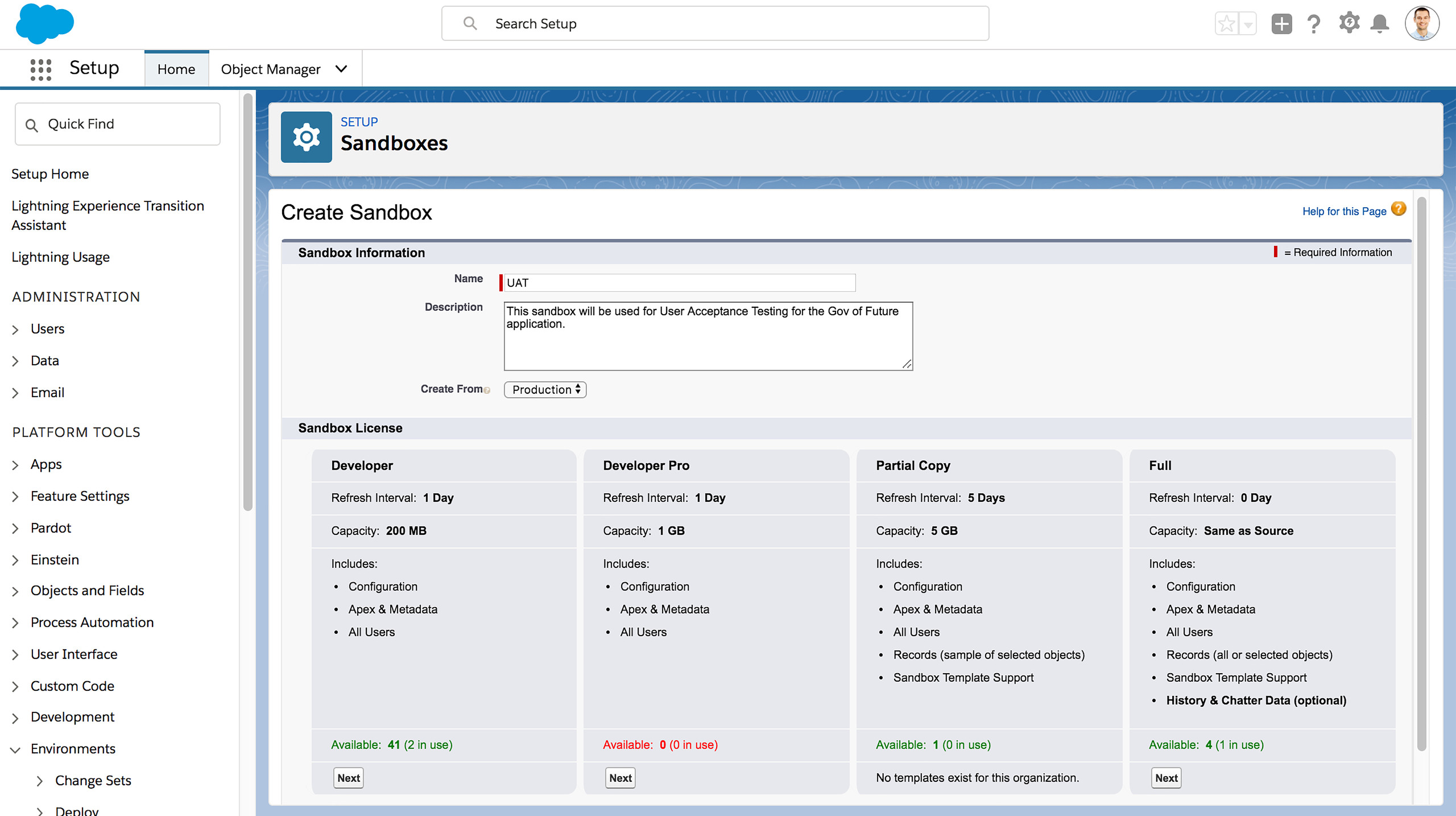
There are several types of Salesforce Sandboxes, each serving specific needs:
Salesforce Sandbox

  • Developer Sandbox: Ideal for individual developers or small teams, Developer Sandboxes provide a copy of the production environment for coding and testing customizations, integrations, and applications.
  • Developer Pro Sandbox: Similar to Developer Sandboxes but with larger storage capacity, Developer Pro Sandboxes offer more space for testing larger configurations and data sets.
  • Partial Copy Sandbox: Partial Copy Sandboxes contain a subset of production data, along with metadata, allowing for more realistic testing scenarios while still conserving resources. They are suitable for comprehensive testing and training.
  • Full Sandbox: Full Sandboxes mirror the entire production environment, including data, configurations, and metadata. They are used for extensive testing, training, and staging of major changes or releases before deployment to production.
  • Configuration-only Sandbox: Configuration-only Sandboxes include only metadata, excluding data records. They are primarily used for testing configuration changes and deployments without affecting data integrity.

Salesforce Sandboxes play a critical role in the development lifecycle, enabling organisations to innovate, iterate, and ensure the quality of their Salesforce implementations before introducing changes to the live environment.

Step-by-Step Salesforce Development Lifecycle Guide

The Salesforce Development Lifecycle encompasses a series of stages aimed at designing, developing, testing, deploying, and maintaining Salesforce solutions. At its core lies the principle of iterative improvement, where feedback loops and continuous refinement drive innovation and agility.

The Salesforce Development Lifecycle unfolds in a series of meticulously planned steps, ensuring the smooth evolution of applications from conception to production deployment.

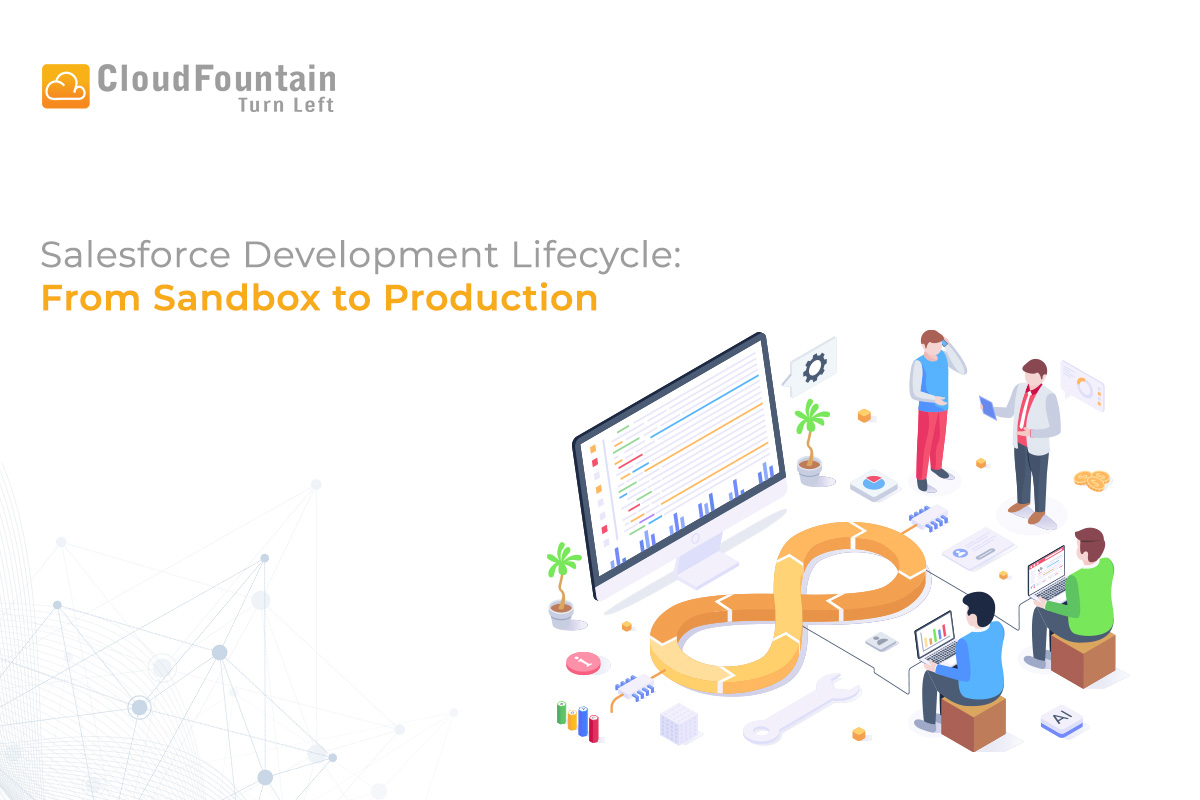
Below is an image of the Salesforce lifecycle:

Understanding the Salesforce Development Lifecycle

Step 1: Source Control Setup

Let’s say your individual developer wants to work on different parts of the project separately, like one person working on adding new features while another person fixes bugs. We create smaller branches, like branches on the tree, for each of these tasks. This way, everyone can work on their part without getting in each other’s way.

And when we need to move things from one branch to another or from our personal computer to the main folder, we use a special tool provided by Salesforce to help us do that. It’s like a magic wand that helps us move things around smoothly and safely.

Step 2: Coding Begins

When development starts, developers create their own “sandbox” – like a playground where they can test things out without breaking anything in the real system. This sandbox looks just like the main system we use, but it’s separate and safe to play in.

Using tools provided by Salesforce, developers connect their sandbox to the main system and grab all the important information they need to work on their project. It’s like taking a snapshot of the main system and putting it in their sandbox.

Then, they start working on their part of the project, making changes and testing them out to make sure everything works as it should. Once they’re happy with their changes, they save them and send them back to the main system, where they’ll be added to the project for everyone to see.

Other developers can then build on those changes, adding their own improvements or fixing any issues that come up. It’s like passing a baton in a relay race – each developer takes their turn working on the project, making sure everything runs smoothly and nothing gets lost along the way.

Step 3: Testing

When it’s time to test the project to make sure everything works correctly, Quality Assurance (QA) experts step in. They have their own special sandboxes – like playgrounds – where they can test the project without affecting the main system.

For thorough testing, they might use what’s called Partial Copy sandboxes. These sandboxes are like mini-versions of the main system, but they only have certain parts of it. This helps them focus on testing specific features without getting distracted by everything else.

The QA experts work together to try out different parts of the project and give feedback on what’s working well and what needs fixing. It’s like checking a car to make sure all the parts are working smoothly before it hits the road. Their goal is to make sure the project is in tip-top shape and ready for everyone to use.

Step 4: User Acceptance Testing and Training

Once the testing is done and everything looks good, it’s time for a final check called User Acceptance Testing (UAT). This is where the people who will actually be using the project – like the developers, managers, and other important folks – get to give it a try.

They use special sandboxes that let them test out the project and make sure it works the way they want it to. These sandboxes are like test kitchens where they can try out different recipes before serving them to customers.

During this testing, they look for any problems or things that need to be fixed. They also use this time to get familiar with the project and prepare any materials they might need to help others learn how to use it.

The goal is to make sure everyone is happy with how the project turned out and feels ready to start using it for real. It’s like giving a new recipe a taste test before serving it to guests – you want to make sure it’s just right before sharing it with others.

Step 5: Final Release to Production

The app undergoes performance testing in an intermediate sandbox environment mirroring production configurations and data. Rigorous testing and regression checks validate the app’s readiness for deployment. Once all criteria are met, the app is released into the production environment, marking the culmination of the development lifecycle.

Through meticulous planning, collaboration, and iterative refinement, Salesforce Development Lifecycle ensures the delivery of high-quality, robust applications tailored to meet business needs.

What are Salesforce Development Models?

Salesforce development models refer to the different approaches or methodologies that organisations adopt when building and managing Salesforce applications and customizations. These models outline the processes, workflows, and best practices for designing, developing, testing, deploying, and maintaining Salesforce solutions. Here are some common Salesforce development models:

  • Waterfall Model: The Waterfall model is a traditional linear approach to development, where each phase (requirements gathering, design, development, testing, and deployment) is completed sequentially. It’s characterised by its structured and rigid nature, with minimal flexibility for changes once development begins.
  • Agile Model: Agile development is an iterative and collaborative approach that emphasises flexibility, adaptability, and customer feedback. It breaks development into small, incremental iterations called sprints, with each sprint delivering a working product increment. Agile promotes continuous improvement, rapid delivery of value, and close collaboration between developers and stakeholders.
  • Scrum: Scrum is a specific agile framework that defines roles, events, and artifacts for managing development projects. It involves short, time-boxed sprints, daily stand-up meetings, and regular reviews and retrospectives to foster transparency, communication, and continuous improvement.
  • Kanban: Kanban is another agile framework that visualises work as a flow of tasks on a Kanban board. Each task moves through various stages (e.g., to-do, in progress, done) to completion. Kanban emphasises limiting work in progress, balancing demand with capacity, and continuously improving workflow efficiency.
  • DevOps Model: DevOps is a culture and set of practices that integrates development and operations teams to streamline the software delivery process and improve collaboration, automation, and deployment frequency. In the context of Salesforce, DevOps principles can enhance development efficiency, reduce time to market, and increase overall system reliability.
  • Hybrid Models: Organisations may also adopt hybrid development models that combine elements of different methodologies to suit their specific needs and preferences. For example, a company might use Agile practices for rapid development and iteration while incorporating Waterfall principles for regulatory compliance or long-term planning.

When it comes to Salesforce development models, making the right choice is crucial for the success of your projects. At CloudFountain, we understand the importance of selecting the right approach tailored to your unique needs and objectives. With our wealth of experience and expertise in Salesforce solutions, we offer guidance and support to help you navigate the various development models available.

Whether you’re embarking on a small-scale project or a large-scale enterprise implementation, we provide the insights and assistance needed to choose the most suitable development model for your organisation. Our team works closely with you to assess factors such as project scope, team size, organisational culture, and customer requirements, guiding you towards the model that aligns best with your goals.

By selecting the appropriate development model and adhering to industry best practices, you can optimise your Salesforce development processes, deliver high-quality solutions, and drive business success. With CloudFountain as your Trusted Salesforce Consulting Partner, you can rest assured that your Salesforce projects will be handled with expertise, precision, and a commitment to delivering results that propel your organisation forward.

Contact us today to learn more about how we can help you choose the right Salesforce development model and unlock the full potential of your Salesforce implementation. Let’s embark on this journey together and pave the way for your organisation’s success.

Conclusion: Navigating the Path to Success

The Salesforce Development Lifecycle is a journey marked by collaboration, iteration, and innovation. From Sandbox to Production, each stage presents unique challenges and opportunities for growth. By embracing best practices, leveraging powerful development tools, and prioritising user-centric design, organisations can unlock the full potential of Salesforce, driving transformative change and realising their vision of success.

As businesses embark on their Salesforce journey, navigating the Development Lifecycle with purpose and precision is key to unlocking the platform’s full potential and achieving sustainable growth in today’s digital landscape. With a strategic approach and a commitment to excellence, organisations can harness the power of Salesforce to drive innovation, elevate customer experiences, and propel their businesses forward into a brighter future.

Categories Artificial Intelligence, Generative AI, Salesforce, Salesforce Einstein

Unlocking the Power of AI: Salesforce Einstein Features and Benefits

Unlocking the Power of AI - Salesforce Einstein Features and Benefits

Salesforce Einstein Generative AI is your partner to enhance personalised customer experience. Get ready to travel to a place where creativity and data collide to create captivating experiences from consumer encounters.

Salesforce Einstein is the leader in personalised engagement in a world where every connection counts. He creates a captivating tapestry of content that is suited to each individual. So buckle up, adventurer, and get ready to discover all that Salesforce Einstein Generative AI has to offer.

Now let’s get the adventure started!

Understanding Salesforce Einstein

Salesforce Einstein Generative AI revolutionises customer interactions by seamlessly integrating data, context, and personalised content generation. Here’s a breakdown of how it works:

    1. Connect: Quality content begins with quality data. Salesforce Einstein leverages pre-built connectors to seamlessly integrate external data sources into Salesforce. Through the Data Cloud, this data undergoes cleansing and preparation, becoming readily available for Salesforce Einstein’s use.
    2. Prompt: With the connected data stored in Salesforce, Salesforce Einstein gains an understanding of your business context. By grounding the large language model with instructions and relevant data, Salesforce Einstein ensures that generated responses are tailored to your specific needs. Utilising various grounding techniques, Salesforce Einstein refines its comprehension using real data.
    3. Trust Layer: Embedded within the platform is the Trust Layer, ensuring data security. When accessing customer data, stringent security measures are employed to protect sensitive information. Post-generation, data is immediately masked and forgotten by the AI model, ensuring confidentiality.
    4. Generate: Leveraging insights gleaned from your company and customer data, Salesforce Einstein generates personalised content across various channels. Whether you’re a customer service representative, salesperson, or programmer, Salesforce Einstein provides tailored recommendations and automates tasks to enhance productivity.

For customer service reps, Salesforce Einstein offers real-time response recommendations across multiple channels. Sales reps benefit from personalised outreach messages, while programmers can automate code generation. Commerce websites can leverage Salesforce Einstein to craft compelling product descriptions.

Einstein’s ability to create personalised experiences in every piece of content empowers businesses to build stronger customer relationships. By impressing customers with tailored experiences, Salesforce Einstein ensures that each interaction leaves a lasting impact.

Discover how AI transforms possibilities into realities, propelling your business toward unparalleled success.

  • Einstein for Sales: Predictive insights for revenue growth.
  • Einstein for Service: Automated support with personalised experiences.
  • Einstein for Marketing: Targeted campaigns that drive engagement.
  • Einstein for Lightning Platform: AI-infused applications for enhanced user experiences.
  • Einstein for Analytics: Data-driven decisions with predictive modelling.
  • Einstein for Commerce: Personalised e-commerce journeys for increased conversions.

Features of Salesforce Einstein

Salesforce Einstein AI Features

Customer engagement is revolutionised by Salesforce Einstein Generative AI, which integrates data, AI capabilities, and CRM functionalities effortlessly. The Salesforce Einstein product catalogue is divided into the following sections by this guide:

Einstein for Sales

This suite of tools is designed to empower sales teams with actionable insights and predictive analytics. It includes features such as lead scoring, opportunity insights, and predictive forecasting, enabling sales professionals to identify the most promising leads, prioritise opportunities, and forecast revenue with greater accuracy.

Related: How to Set up Sales Cloud Einstein in Salesforce?

Einstein for Service

Geared towards enhancing customer service operations, this set of tools leverages AI to streamline support processes, automate case routing, and deliver personalised customer experiences. With features like intelligent case classification, sentiment analysis, and Chatbot integration, service teams can resolve issues faster, anticipate customer needs, and drive customer satisfaction.

Einstein for Marketing

Marketers can harness the power of AI to deliver targeted, personalised campaigns across multiple channels with Salesforce Einstein for Marketing. This suite includes capabilities such as predictive segmentation, email marketing automation, and content recommendations, enabling marketers to optimise engagement, drive conversions, and maximise ROI.

Einstein for the Lightning Platform

Developers can infuse AI capabilities into their custom applications using Salesforce Einstein for the Lightning Platform. This suite provides pre-built AI models, APIs, and tools for building intelligent applications, enhancing productivity, and delivering innovative user experiences.

Einstein for Analytics

Unlock the full potential of data with Salesforce Einstein for Analytics. This suite offers advanced analytics and AI-powered insights, enabling organisations to uncover hidden patterns, make data-driven decisions, and drive business growth. Features include predictive modelling, automated insights, and natural language processing for querying data.

Einstein for Commerce

Transform e-commerce experiences with Salesforce Einstein for Commerce. This suite leverages AI to personalise product recommendations, optimise pricing strategies, and improve conversion rates. With features like predictive search, dynamic pricing, and personalised merchandising, retailers can deliver tailored shopping experiences that drive customer loyalty and revenue.

Each section of the Salesforce Einstein product catalogue is tailored to address specific business needs and objectives, empowering organisations to harness the power of AI across the entire customer lifecycle – from sales and service to marketing, analytics, and commerce.

Benefits of Salesforce Einstein

Salesforce Einstein, with its dual capabilities of predictive AI and generative AI, offers a myriad of benefits to businesses. Predictive AI leverages existing data to forecast future outcomes, empowering organisations to make informed decisions and strategize effectively.

On the other hand, generative AI enables the creation of original content, spanning text, images, and videos, fostering creativity and innovation. By seamlessly integrating data, AI, CRM, and trust, Salesforce Einstein elevates revenue generation, strengthens customer relationships, and adds tangible business value.

The result? Highly personalised experiences that resonate with customers, driving engagement, loyalty, and ultimately, business success. With Salesforce Einstein, businesses unlock the power of AI to propel their growth and competitive advantage in today’s dynamic marketplace.

Salesforce Einstein Benefits

  • Enhanced Productivity: By automating repetitive tasks and providing intelligent recommendations, Salesforce Einstein enables businesses to streamline their workflows and boost productivity across the organisation. Whether it’s sales, marketing, customer service, or IT, Salesforce Einstein’s AI capabilities empower users to focus on high-value activities while AI handles the rest.
  • Personalised Experiences: In today’s hyper-connected world, customers expect personalised experiences tailored to their unique preferences and needs. Salesforce Einstein enables businesses to deliver hyper-personalised experiences at every touchpoint, from targeted marketing campaigns to proactive customer support, driving customer satisfaction and loyalty.
  • Data-driven Decision Making: With Salesforce Einstein’s predictive analytics capabilities, businesses can harness the power of data to make informed decisions and drive strategic initiatives. By leveraging AI-driven insights, organisations can identify emerging trends, forecast future outcomes, and stay ahead of the competition in a rapidly evolving market landscape.
  • Scalability and Flexibility: Whether you’re a small startup or a global enterprise, Salesforce Einstein offers scalability and flexibility to meet your evolving business needs. With its cloud-based architecture and modular design, Salesforce Einstein seamlessly integrates with existing Salesforce applications and can be customised to suit your specific requirements, ensuring maximum ROI and long-term success.
  • Continuous Innovation: As AI technology continues to evolve, so does Salesforce Einstein. With regular updates and new features introduced by Salesforce, businesses can stay at the forefront of innovation and leverage the latest advancements in AI to drive business growth and stay ahead of the competition.

You can see why integrating Salesforce CRM into your company can enhance your customer relationship. Integrating Salesforce CRM is not that simple. The varied tools offered by Salesforce CRM and integrating all of them may not be the right fit for every organisation. CloudFountain understands this struggle and has a Salesforce QuickStart Package.

Related: How to Implement Salesforce Einstein: A Guide to Unleashing AI in your CRM

Salesforce QuickStart Packages expedite Salesforce implementation with predefined services for speedy setup. Tailored for small businesses, nonprofits, and growing companies, they offer cost-effective solutions with minimised risks and expert guidance. With a focused scope, these packages ensure a successful outcome and improved user adoption through basic training.

They include data migration support, customization, and documentation, accelerating ROI. Each package delivers a configured Salesforce solution, scalable foundation, best practices, automation, and tailored reports. Remote or hybrid engagement options are available, along with end-user and admin training, ensuring long-term success and a roadmap for future transformation. Let CloudFountain be your partner for the successful Salesforce Integration into your business.

Final Thought

In conclusion, Salesforce Einstein represents the next frontier of AI-driven innovation, empowering businesses to unlock the full potential of their data, automate processes, and deliver exceptional customer experiences.

By harnessing the power of predictive analytics, machine learning, natural language processing, and other AI capabilities, organisations can transform their operations, drive growth, and stay ahead in today’s rapidly evolving digital landscape.

Whether you’re a small business looking to scale or a large enterprise seeking to innovate, Salesforce Einstein provides the tools and capabilities you need to succeed in the age of AI.

Categories ISO 27001 Compliance

Best Practices for Achieving ISO 27001 Compliance

Best Practices for Achieving ISO 27001 Compliance

In a world plagued by cyberattacks and security lapses, headlines of stolen data and breached defenses are all too frequent. Behind the scenes, organizations rely on increasing complex IT technology to help them accomplish their goals more quickly.

Such systems typically hold data that is extremely important from a strategic standpoint. Nevertheless, the majority of these systems lack sufficient integrated security features. It is the responsibility of management to guarantee that policies and procedures support system and data security.

In this blog, we will look at ISO 27001 compliance and some of the best practices around it.

What is the International Organization for Standardisation (ISO) 27001 Compliance?

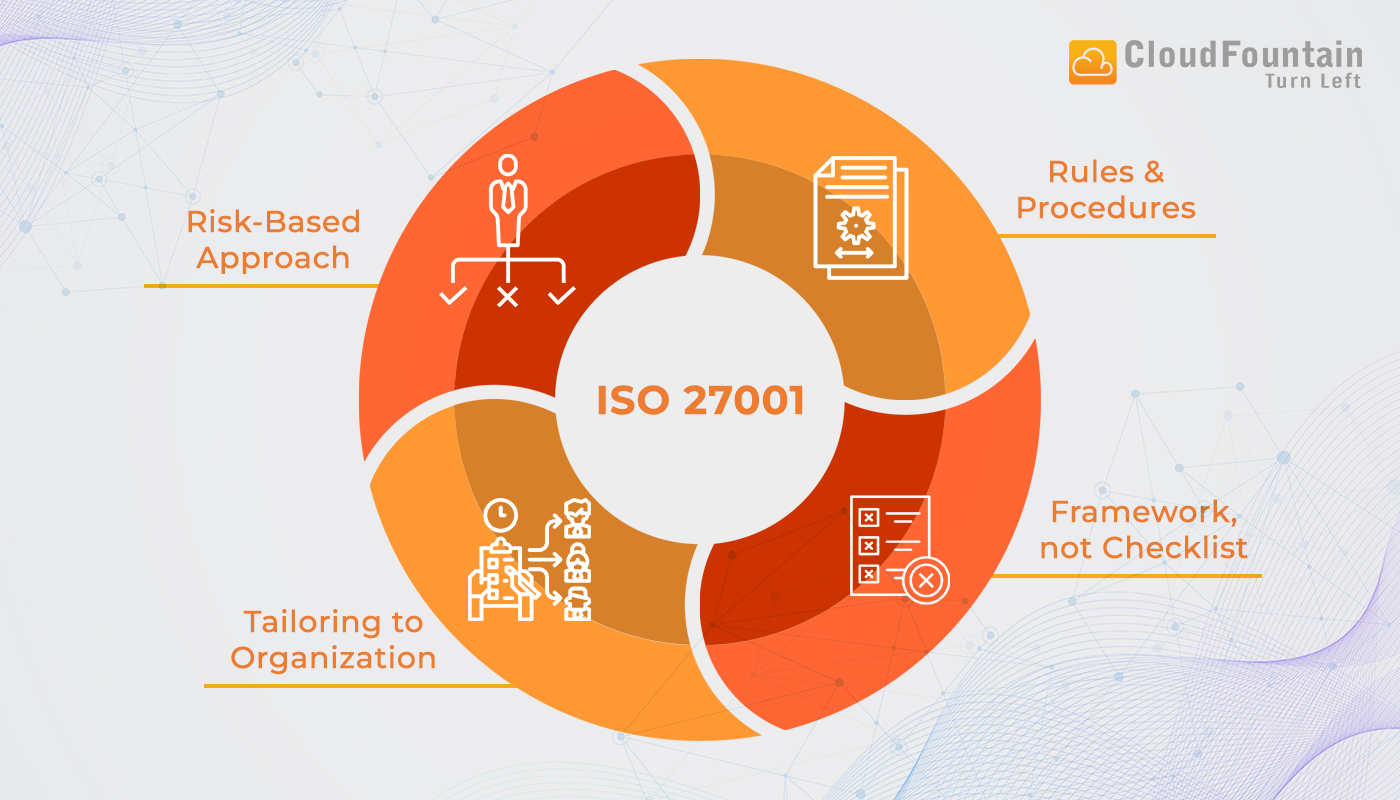
ISO 27001 is a standard providing a framework for establishing, implementing, maintaining, and continually improving an Information Security Management System (ISMS) within an organization. However, unlike a prescriptive checklist of specific tasks to be completed, ISO 27001 offers a set of requirements, principles, and guidelines that organizations must interpret and apply in a manner that is relevant and appropriate to their unique context, risks, and business objectives.

ISO 27001 Compliance

Here’s a breakdown of what this means:

  • Rules and Procedures: ISO 27001 defines requirements and recommendations related to various aspects of information security management, such as risk assessment, controls implementation, documentation, monitoring, and improvement. These requirements provide a structured framework for organizations to follow but do not dictate exactly how each requirement should be met.
  • Framework, not Checklist: ISO 27001 serves as a framework rather than a checklist. It outlines the elements that should be included in an ISMS but allows organizations flexibility in how they implement these elements. This flexibility is necessary because different organizations operate in different contexts and face unique risks, so a one-size-fits-all approach would not be practical or effective.
  • Tailoring to Organization: Organizations are responsible for tailoring the requirements of ISO 27001 to their specific needs, circumstances, and risk profiles. This involves conducting a thorough risk assessment to identify information security risks, determining the appropriate controls and measures to address these risks, and integrating information security practices into existing business processes and structures.
  • Risk-Based Approach: ISO 27001 emphasises a risk-based approach to information security management. This means that organizations prioritise their efforts and resources based on the severity and likelihood of potential risks to their information assets. They focus on mitigating the most significant risks while accepting or managing lower-priority risks in a cost-effective manner.

Achieving ISO 27001 compliance requires more than just blindly following a checklist of tasks.

It requires a thoughtful and systematic approach to interpreting the standard’s requirements, assessing risks, implementing controls, and continuously improving information security practices to meet the organization’s unique needs and objectives.

What is an Information Security Management System (ISMS)?

The ISMS is the system of management that is being used to implement ISO 27001. This systematic approach helps in managing sensitive company information, ensuring its confidentiality, integrity, and availability.

An effective ISMS helps organizations protect their information assets from unauthorized access, disclosure, alteration, or destruction, thereby safeguarding the confidentiality, integrity, and availability of sensitive information.

It also helps organizations comply with legal, regulatory, and contractual requirements related to information security and data protection. An ISMS is a vital component of an organization’s overall risk management strategy and demonstrates its commitment to information security best practices.

Best Practices for Achieving ISO 27001 Compliance

Best Practices for ISO 27001 Compliance

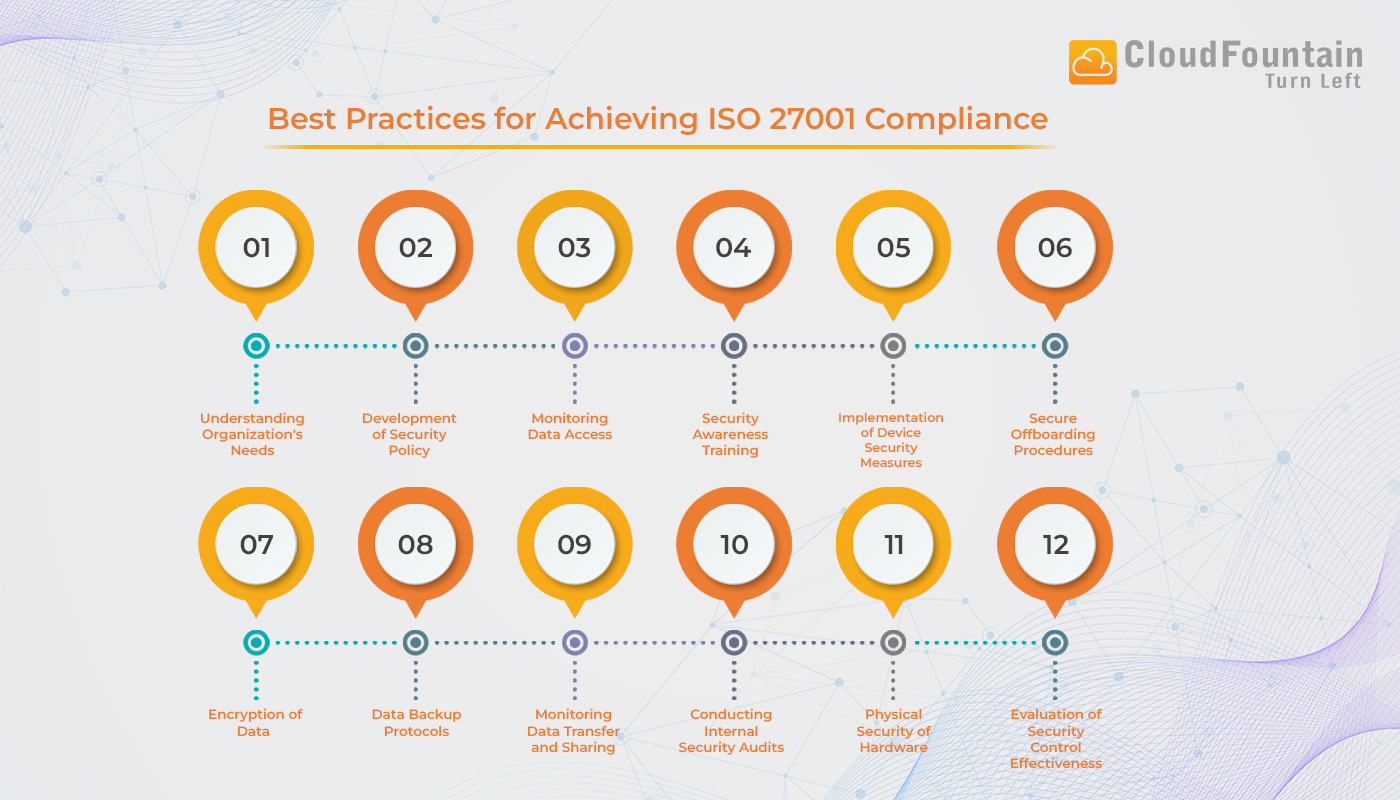
    1. Understanding Organization’s Needs: The initial step for the organization is to assess its needs and requirements from the operations and information security management system. Once that is done the next step is to see how the ISO 27001 framework can help the organization with their data security requirements.
    2. Development of Security Policy: Defining a security policy will give your organization a clear picture of the security control, and management and implementation of the ISO 27001.
    3. Monitoring Data Access: Keeping a check of the personnel having access to the company’s data. This will ensure the authenticity of the data. This includes staying updated on who, when, and where they access your data. Keep a check on logins and make sure your login logs are preserved for future reference as a subtask.
    4. Security Awareness Training: While implementing the ISO 27001 it’s important that the incentive for the implementation is not limited to the IT department and manager. Training your employees to recognise data security threats and ways to prevent it from being compromised is essential.
    5. Implementation of Device Security Measures: Safety measures for protecting the data from physical damage and hacking will help your organization prevent disruption of important data.
    6. Secure off-boarding Procedures: It is necessary to create safe off-boarding protocols. Unless there is a compelling cause, a departing employee shouldn’t be able to access your system, and your business should keep any pertinent data safe.
    7. Encryption of Data: One of the best methods for protecting data is encryption. A secure encryption will keep unwanted parties from accessing your information.
    8. Data Backup Protocols: Protect yourself from data loss with robust backup policies. You should designate the location, frequency, duration of data retention, and security protocols for both on-premise and cloud backups in addition to backing up your data.
    9. Monitoring Data Transfer and Sharing: To stop unauthorized people from accessing your data, you must put in place the proper security measures.
    10. Conducting Internal Security Audits: Perform regular audits of your security devices, apps, and systems. This will assist you in locating possible security holes and solutions.
    11. Physical Security of Hardware: You must protect the hardware (including devices) used by your business from several types of physical damage.
    12. Evaluation of Security Control Effectiveness: It is not enough to simply have security rules in place; you also need to assess their efficacy. If you utilize a backup, for instance, you can measure the recovery time and success rate to determine the efficacy of your backup system.

Why choose CloudFountain for implementation of ISO 27001 Compliance?

Choosing CloudFountain as your trusted partner for the implementation of ISO 27001 in your organization ensures that you have access to specialised expertise, streamlined methodologies, and tailored solutions tailored to meet your unique needs.

  • We prioritise efficiency and speed, expediting the implementation process to help your organization achieve ISO 27001 Certification more quickly and saving you time and resources.
  • Dedicated project management expertise ensures that the implementation process stays on track to meet deadlines and milestones.
  • We provide tailored solutions to meet your organization’s specific needs and requirements, conducting thorough assessments to identify unique risks and develop customised solutions.
  • CloudFountain offers guidance, training, and support to manage changes to organizational processes, procedures, and culture effectively.
  • Our external perspective, gained from working with a variety of organizations, ensures a more robust ISMS by identifying blind spots or overlooked areas.
  • While there are upfront costs, partnering with CloudFountain is a cost-effective investment, helping to avoid costly mistakes and ensuring efficient resource allocation.
  • We offer continuous support and maintenance services post-certification, including assistance with audits, reviews, and updates to the ISMS.

With CloudFountain as your partner, you can navigate your digital transformation journey with confidence, embracing a future where your organization flourishes in the digital realm.

Categories Generative AI, Startups

The Impact of Generative AI on Startups

The Impact of Generative AI on Startups

Innovation is key in the fast-paced world of startup companies. These startups are always looking for new methods to set themselves apart from the competition as they work to upend industries and carve out a place for themselves in the market. Generative Artificial Intelligence (GenAI) is one technological advancement that has been causing a stir within the startup community.

Generative AI represents a significant breakthrough in AI technology, enabling machines to autonomously create new content, images and solutions. This capability has profound implications for startups, offering them a powerful tool to enhance creativity, streamline operations, and drive growth. In this blog, we’ll explore the transformative impact of Generative AI on startups and how it is reshaping the way these companies innovate and succeed in today’s hyper-competitive landscape.

Effects of Generative AI on Startups

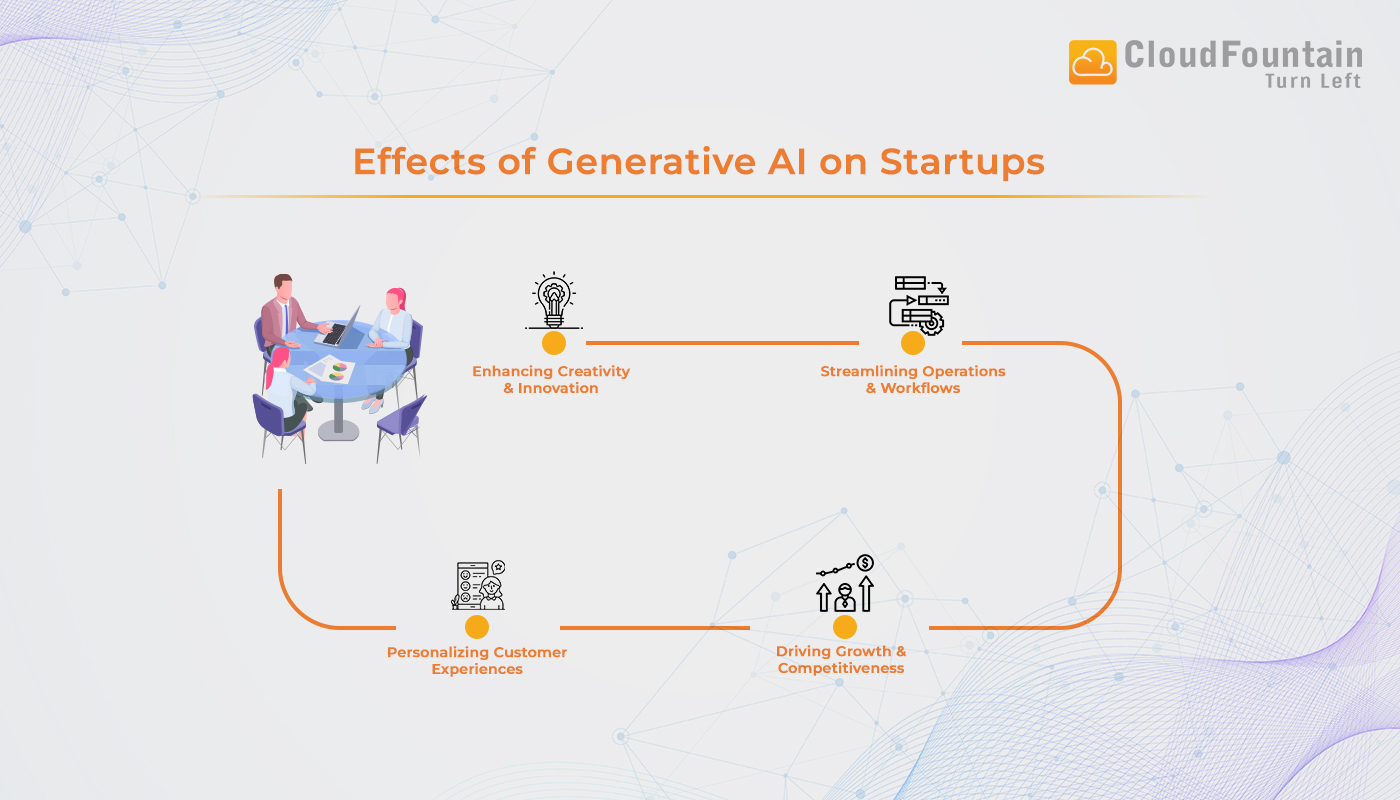
Enhancing Creativity and Innovation

Creativity lies at the heart of every successful startup. Whether it’s developing a groundbreaking product, crafting a compelling brand identity, or devising innovative marketing strategies, creativity is the driving force behind entrepreneurial success. Generative AI takes creativity to the next level by providing startups with the ability to generate new ideas, designs, and concepts at scale.

By harnessing the power of Generative AI, startups can unlock a wealth of creative possibilities. They can use AI-generated content to inspire new product concepts, explore alternative design options, and experiment with novel marketing campaigns. This not only accelerates the innovation process but also gives startups a competitive edge by enabling them to bring fresh, innovative ideas to market faster than ever before.

Streamlining Operations and Workflows

In addition to fueling creativity, Generative AI also offers startups a powerful tool for streamlining operations and workflows. From automating repetitive tasks to optimising resource allocation, AI-driven automation can help startups operate more efficiently and effectively.

For example, startups can use Generative AI to automate mundane tasks such as data entry, document generation, and customer support inquiries. This frees up valuable time and resources that can be redirected toward more strategic initiatives, such as product development, marketing, and customer acquisition. By automating routine tasks, startups can increase productivity, reduce costs, and improve overall operational efficiency.

Personalising Customer Experiences

In today’s digital age, personalised customer experiences are essential for driving engagement, loyalty, and retention. Generative AI empowers startups to deliver highly personalised experiences by analysing customer data and generating tailored content and recommendations.

For instance, startups can use Generative AI to create personalised marketing campaigns, product recommendations, and customer communications. By leveraging AI-generated insights, startups can better understand their customers’ preferences, behaviours, and needs, allowing them to deliver targeted messaging and offers that resonate with their audience. This not only enhances the customer experience but also increases the likelihood of conversion and repeat business.

Driving Growth and Competitiveness

Ultimately, the impact of Generative AI on startups extends far beyond individual processes or functions. By fueling creativity, streamlining operations, and personalising customer experiences, Generative AI empowers startups to drive growth, innovation, and competitiveness in the market.

Startups that embrace Generative AI are better positioned to differentiate themselves from competitors, adapt to changing market dynamics, and capitalise on new growth opportunities. Whether it’s launching innovative products, scaling operations, or expanding into new markets, Generative AI provides startups with the tools and capabilities they need to thrive in today’s dynamic business environment.

How can you Integrate Generative AI into your Workflow?

In an environment of scarce resources and intense rivalry, startups need to constantly innovate, optimise processes, and provide customers with outstanding experiences. A game-changing tool that is drastically altering the startup scene is Salesforce Generative AI.

  • Unleashing Creativity and Speed: Salesforce Generative AI accelerates innovation by automating prototyping and iteration processes. Startups can bring ideas to life quickly, gather feedback, and iterate rapidly based on customer insights.
  • Personalized Engagement at Scale: By dynamically generating marketing campaigns and content, Salesforce Generative AI enables startups to engage customers on a personal level. This personalised approach fosters loyalty and drives long-term growth.
  • Data-Driven Decision Making: Harnessing predictive analytics, startups gain insights into market trends and customer behaviour. This enables informed decisions, optimised strategies, and staying ahead of the competition.
  • Streamlined Operations and Growth: With automation and optimization, startups can streamline operations, reduce costs, and scale effectively. Salesforce Generative AI frees up time and resources for strategic initiatives.
  • Embracing Opportunities: While challenges exist, overcoming them is part of the journey. With the right mindset and resources, startups can harness the full potential of Salesforce Generative AI for unprecedented growth and innovation.

Partnering with CloudFountain for the integration of Salesforce Generative AI into your workflow brings unparalleled expertise and experience to the table. As a Salesforce Application Development Company based in Boston, USA, CloudFountain understands the intricate nuances of Salesforce and the transformative potential of Generative AI. With a qualified team of developers, analysts, architects, and more, CloudFountain offers comprehensive consultation, development, migration, implementation, and customization services tailored to your specific needs.

By leveraging the power of Salesforce Generative AI, CloudFountain helps startups accelerate innovation, personalise customer engagement, harness data for strategic advantage, and streamline operations for maximum efficiency and growth. With a proven track record of delivering robust, reliable, and scalable Salesforce solutions, CloudFountain is your trusted partner in navigating the complexities of integrating Generative AI into your workflow.

Conclusion

In conclusion, Generative AI represents a game-changing technology for startups, offering a myriad of opportunities to enhance creativity, streamline operations, and drive growth. By leveraging the power of Generative AI, startups can unlock new levels of innovation, efficiency, and competitiveness, enabling them to succeed in an increasingly competitive and disruptive market landscape. As Generative AI continues to evolve and mature, its impact on startups is only expected to grow, shaping the future of entrepreneurship and innovation for years to come.

Categories Generative AI, Salesforce

Future of Salesforce with Generative AI

Future of Salesforce with Generative AI

Salesforce is a cloud-based software company renowned for its customer relationship management (CRM) platform. Founded in 1999, Salesforce revolutionised the way businesses manage and interact with their customers by providing a centralised platform for sales, marketing, and customer service activities. Today, Salesforce is a market leader in CRM solutions, serving businesses of all sizes and industries globally.

Introduction to Generative AI

Generative AI refers to a subset of artificial intelligence focused on generating new content or data that resembles human-created output. Unlike traditional AI models that are designed for specific tasks, generative AI systems have the ability to create original content autonomously based on patterns learned from large datasets. This technology has shown promise in various industries, including art, design, healthcare, and entertainment.

This blog explores the intersection of Salesforce and generative AI, investigating how the integration of these technologies can shape the future of businesses. By examining the potential applications, challenges, and implications, we aim to provide insights into the transformative potential of leveraging generative AI within the Salesforce ecosystem.

Related: How Custom Generative AI Solutions Can Revolutionise Your Business

Understanding Salesforce

Salesforce offers a comprehensive suite of CRM tools designed to streamline and automate various aspects of customer relationship management. From lead generation to post-sales support, Salesforce provides functionalities such as lead management, opportunity tracking, marketing automation, and customer service management, all accessible through a user-friendly interface.

Key Features and Functionalities

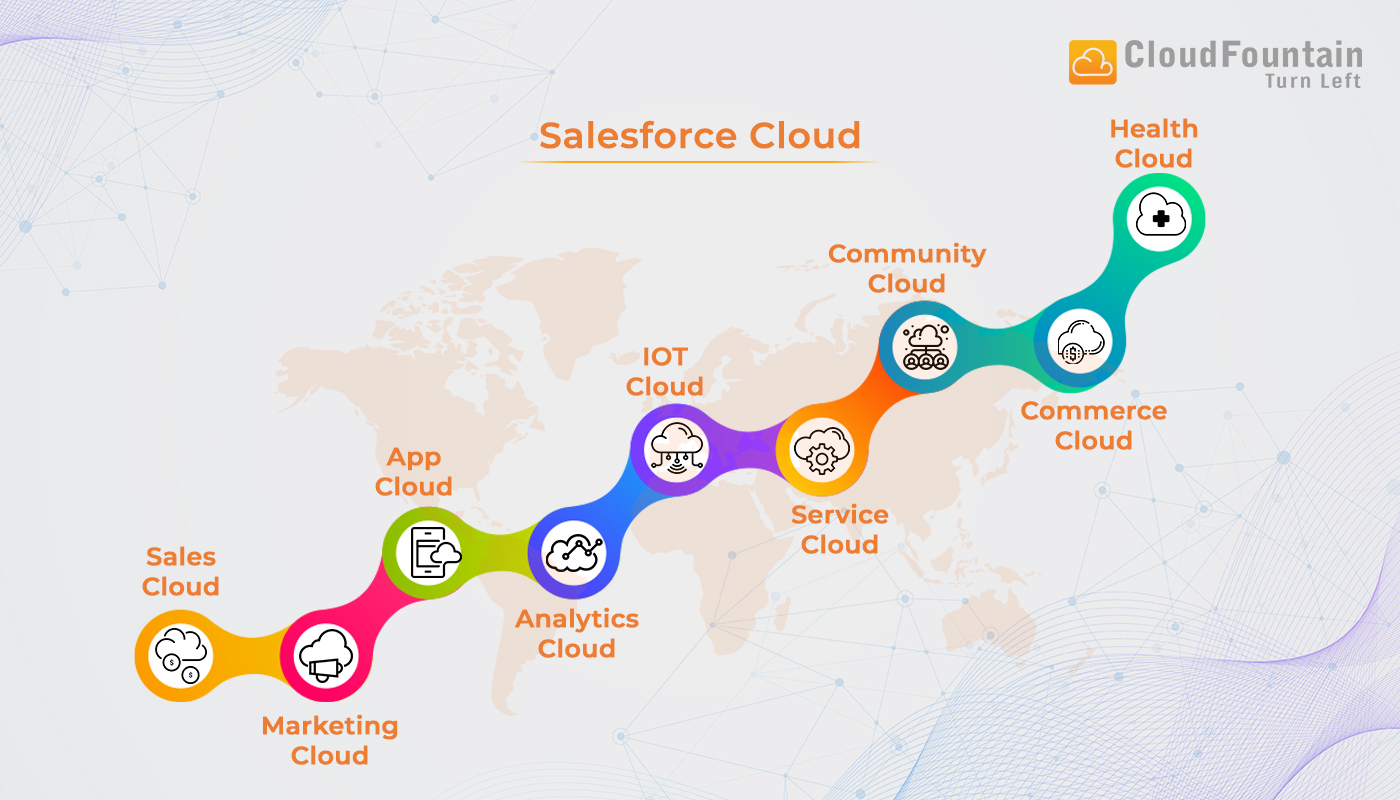
Types of Salesforce Clouds

Some key features of Salesforce include customizable dashboards, workflow automation, collaborative tools, and integration with third-party applications. Additionally, Salesforce offers a wide range of specialised solutions tailored to specific industries and business needs, such as Salesforce Sales Cloud, Service Cloud, Marketing Cloud, and Commerce Cloud.

Importance of Salesforce

Salesforce plays a crucial role in driving sales growth, improving customer engagement, and enhancing operational efficiency for businesses across various sectors. By centralising customer data and providing actionable insights, Salesforce empowers organisations to deliver personalised experiences, optimise sales processes, and build lasting customer relationships.

Types of Generative AI Models

Popular generative AI models include OpenAI’s GPT (Generative Pre-trained Transformer) series, which excels at generating coherent text based on prompts, and DALL-E, which generates images from textual descriptions. Other examples include StyleGAN for image generation and MuseNet for music composition.

Generative AI has found applications in diverse fields, from natural language processing and image synthesis to creative content generation and drug discovery. For instance, generative AI can be used to generate realistic images for design prototyping, create personalised product recommendations for e-commerce platforms, or even assist in generating novel drug compounds for pharmaceutical research.

Current Applications of AI in Salesforce

Salesforce has been at the forefront of integrating AI capabilities into its platform to enhance user experience and drive business value. Through its Einstein AI suite, Salesforce offers a range of AI-powered features and tools that enable users to automate tasks, gain predictive insights, and deliver personalised experiences to customers.

AI-Driven Features

Einstein Analytics leverages machine learning algorithms to analyse data and uncover actionable insights, helping businesses make informed decisions and identify trends. Einstein Prediction Builder enables users to create custom predictive models without writing code, allowing for accurate sales forecasting and lead scoring. Additionally, Einstein Bots uses natural language processing to automate customer service interactions, providing real-time support and assistance.

Enhancements to Salesforce Capabilities

By leveraging AI, Salesforce enhances its capabilities in various areas, including sales forecasting, lead prioritisation, customer segmentation, and sentiment analysis. These AI-driven features empower businesses to optimise their sales and marketing strategies, improve customer satisfaction, and drive revenue growth.

Potential of Generative AI in Salesforce

Potential of Generative AI in Salesforce

Integrating generative AI into the Salesforce ecosystem opens up new opportunities for enhancing data analysis, content generation, and customer engagement. For example, generative AI models can be used to generate personalised marketing content, automate email responses, or even assist sales representatives in crafting compelling pitches based on customer preferences.

Enhancing Data Analysis and Insights Generation

Generative AI can augment traditional analytics capabilities by generating synthetic data for training predictive models, simulating various scenarios, or filling in missing data gaps. This can lead to more accurate predictions, better decision-making, and improved overall performance of Salesforce applications.

By leveraging generative AI for natural language understanding and generation, Salesforce can provide more personalised and contextually relevant interactions with customers. Chatbots powered by generative AI can engage in more meaningful conversations, understand complex queries, and provide accurate responses, ultimately enhancing the customer experience.

Challenges and Considerations

The use of generative AI in Salesforce raises ethical concerns regarding the authenticity and manipulation of generated content. Businesses must ensure transparency, fairness, and accountability in their AI-powered interactions with customers to maintain trust and integrity.

Data Privacy and Security

Integrating generative AI into Salesforce requires access to large datasets, raising concerns about data privacy and security. Businesses must implement robust data protection measures and adhere to regulatory requirements to safeguard sensitive customer information and prevent unauthorised access or misuse.

Training and Implementation Challenges

Training and deploying generative AI models within the Salesforce environment present technical challenges, including model optimization, resource allocation, and integration with existing workflows. Businesses need to invest in skilled personnel, infrastructure, and ongoing maintenance to successfully implement generative AI solutions.

Future Outlook

The future of Salesforce with generative AI holds immense potential for innovation and advancement. As generative AI technology continues to evolve, we can expect to see further integration with Salesforce applications, enabling businesses to automate more tasks, personalise interactions, and derive deeper insights from data.

Future advancements in generative AI may lead to the development of more sophisticated models capable of generating highly realistic and contextually relevant content across various modalities. This could revolutionise how businesses engage with customers, design products, and conduct market research within the Salesforce ecosystem.

Businesses that embrace the integration of generative AI into Salesforce stand to gain a competitive edge by leveraging AI-driven insights, automating repetitive tasks, and delivering more personalised experiences to customers. However, success will depend on organisations’ ability to adapt to technological advancements, mitigate risks, and uphold ethical standards.

Related: Boosting Sales And Efficiency: How A Salesforce Application Development Company Can Help

Why Choose CloudFountain as Your Salesforce Implementation Consultant?

As a leading Salesforce Development Company in Boston, USA, CloudFountain offers unparalleled expertise and support to businesses seeking to leverage the full potential of the Salesforce platform. Here’s why you should choose CloudFountain as your trusted consultant for Salesforce implementation:

  • Expertise in Salesforce Solutions: With a team of seasoned developers, analysts, architects, and consultants, CloudFountain brings a wealth of experience and expertise in Salesforce implementation and customization. We understand the intricacies of the Salesforce ecosystem and can tailor solutions to meet your unique business needs.
  • Comprehensive Services: From consultation and development to migration, implementation, and customization, CloudFountain offers end-to-end Salesforce services to help you maximise the value of your investment. Whether you’re looking to extend your capabilities with custom integrations or optimise your existing workflows, we have the skills and resources to deliver results.
  • Focus on Security and Compliance: At CloudFountain, we prioritise the security and compliance of your Salesforce applications. By leveraging the Salesforce platform’s built-in security features and best practices, we ensure that your data remains secure and compliant with industry regulations, giving you peace of mind.
  • Cost-Effective Solutions: Our approach to Salesforce implementation focuses on maximising ROI while minimising costs. Instead of building applications from scratch, we leverage existing Salesforce modules and integrate extended functionalities to deliver cost-effective solutions that increase profitability and drive business growth.
  • Enhanced Productivity and Collaboration: By bringing your vendors, customers, and employees under one roof with Salesforce, CloudFountain helps you organise workflows and streamline communication for elevated productivity. With added features like Service Cloud for customer service and Chatter for internal communication, we empower your teams to work smarter and faster.
  • Industry Experience and Expertise: With a proven track record of delivering robust, reliable, and scalable Salesforce solutions to clients across the nation and beyond, CloudFountain brings unmatched industry experience and expertise to every project. Our consultants have hands-on experience in CRM, sales, marketing, service, and more, enabling us to tailor solutions that align with your business goals.

Ever wish you had a superhero hotline for Salesforce emergencies? Look no further! With CloudFountain, our support doesn’t end at implementation. Whether you need a quick fix, a helping hand, or just a friendly chat, our dedicated team is here for you!

So, what do you say? Ready to embark on a Salesforce journey like no other? Partner with CloudFountain, and let’s make magic happen together!